Image: <a href="https://commons.wikimedia.org/wiki/File:Mid-Autumn_Festival-beijing.jpg" rel="nofollow noopener" target="_blank">Shizhao / Wikimedia Commons</a> (CC BY-SA 2.5)
On one special night each autumn, families across China step outside and look up. The full moon hangs round and bright in the sky, said to be the fullest and most beautiful of the whole year. Children carry glowing paper lanterns shaped like rabbits, fish and stars. Grandparents tell old stories about a lady who lives on the moon. Everyone shares round, rich pastries called mooncakes. This is the Mid-Autumn Festival, also known as the Moon Festival, or Zhōngqiū Jié (中秋节).
After the Spring Festival, the Mid-Autumn Festival is one of the most important traditional holidays in China. It is a time of family reunion, gratitude for the harvest and admiration of the moon. In this article, we will explore its history, its famous legends, its delicious foods and how people celebrate in China and beyond.
When Is the Mid-Autumn Festival?
The festival falls on the fifteenth day of the eighth month of the Chinese lunar calendar, when the moon is full. On the Western calendar, this is usually in September or early October. In 2026, the festival falls on September 25.
“Mid-Autumn” refers to the fact that, in the traditional calendar, autumn includes the seventh, eighth and ninth months, so the fifteenth day of the eighth month is right in the middle of the season.
A Festival of the Harvest and the Moon
The roots of the Mid-Autumn Festival go back thousands of years. In ancient China, emperors made offerings to the moon in autumn, giving thanks for a good harvest and praying for the coming year. By the Tang dynasty (618–907), moon-viewing had become a popular activity among scholars and poets. By the Song dynasty (960–1279), the Mid-Autumn Festival had become a widely celebrated holiday. In 2008, it became an official public holiday in mainland China.
The full moon’s round shape symbolizes completeness and reunion in Chinese culture. That is why the festival is especially about families gathering together. People who cannot be with their loved ones often look at the moon and think of them, knowing that the same moon shines on everyone, wherever they are.
The Legend of Chang’e and Hou Yi
The most famous story connected to the festival is the legend of Chang’e (嫦娥), the goddess of the moon. There are many versions, but here is one popular telling.
Long ago, there were ten suns in the sky. They were brothers who usually took turns crossing the sky, one each day. But one day, all ten rose together. Their heat scorched the earth, dried up rivers and burned crops. People and animals suffered terribly.
A brave and skilled archer named Hou Yi (后羿) climbed a mountain and, with his mighty bow, shot down nine of the suns, leaving just one to give light and warmth. The earth was saved, and Hou Yi became a hero.
As a reward, the Queen Mother of the West gave Hou Yi an elixir of immortality. Whoever drank it would live forever and rise to the heavens. But Hou Yi did not want to leave his beloved wife, Chang’e, so he gave the elixir to her for safekeeping.
One day, while Hou Yi was out hunting, a greedy student named Peng Meng broke into their home and tried to force Chang’e to give him the elixir. To keep it out of his hands, Chang’e drank it herself. Immediately, she began to float upward, rising higher and higher until she reached the moon, the place in the heavens closest to her husband on Earth.
When Hou Yi returned and learned what had happened, he was heartbroken. He looked up at the moon and thought he could see Chang’e there. He set out her favorite fruits and cakes as offerings in the garden. When people heard the story, they began to make offerings to the moon too, praying to Chang’e for good fortune and safety. That is said to be the origin of moon worship on the Mid-Autumn Festival.
The Jade Rabbit
Chang’e is not alone on the moon. She has a companion: the Jade Rabbit (玉兔, Yùtù), who is said to pound herbs with a mortar and pestle to make the elixir of life.
One legend tells that three immortals disguised themselves as hungry old men and asked a fox, a monkey and a rabbit for food. The fox and monkey found food, but the rabbit had nothing to give. So the selfless rabbit offered itself, jumping into a fire to become food for the old men. Touched by its kindness, the immortals saved the rabbit and sent it to live forever on the moon.
When you look at the full moon, try to find the shape of a rabbit in the dark patches. Many people in East Asia see a rabbit pounding a mortar, while people in other cultures see a “man in the moon.”
Other Legends
- Wu Gang and the Osmanthus Tree: A man named Wu Gang was punished by being made to chop down a magical osmanthus tree on the moon. But every time he cut it, the tree healed itself, so he must keep chopping forever.
- Mooncakes and Secret Messages: A popular folk story says that at the end of the Yuan dynasty in the 1300s, rebels hid secret messages inside mooncakes to coordinate an uprising. Historians are not sure this really happened, but it is a fun tale.
Mooncakes: The Taste of the Festival
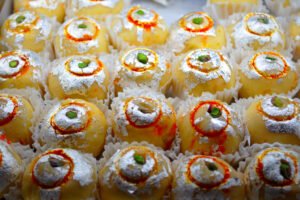
The most famous food of the Mid-Autumn Festival is the mooncake (月饼, yuèbǐng). Mooncakes are round pastries, symbolizing the full moon and family unity. They are often pressed in molds that stamp beautiful designs and Chinese characters on top, such as wishes for long life or harmony.
There are many styles of mooncakes across China:
- Cantonese mooncakes: The most well-known style, with a thin, shiny, golden-brown crust and rich fillings like lotus seed paste or red bean paste. Some contain one or more salted duck egg yolks in the center, representing the full moon.
- Suzhou-style mooncakes: With a flaky, layered crust, sometimes savory, filled with meat.
- Snow skin mooncakes: A modern style with a soft, chewy, unbaked skin made of glutinous rice, served chilled, often in pastel colors with fruity fillings.
- Five-nut mooncakes (wǔrén): Filled with a mix of nuts and seeds.
Today, there are also creative modern mooncakes with flavors like chocolate, green tea, custard, durian, coffee and even ice cream. Mooncakes are very rich, so families usually cut them into small wedges to share. Giving beautifully boxed mooncakes to relatives, friends and coworkers is a common tradition.
Other Festival Foods
- Pomelos: Large citrus fruits, often eaten during the festival. Children sometimes wear the peel as a hat!
- Osmanthus: The fragrant osmanthus flower blooms in autumn and is used in tea, sweets and rice wine.
- Taro, peanuts, persimmons and crabs are also popular in different regions.
How People Celebrate
Family Reunion Dinner
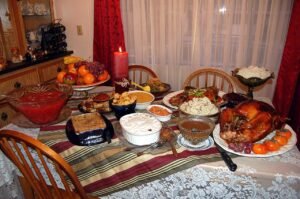
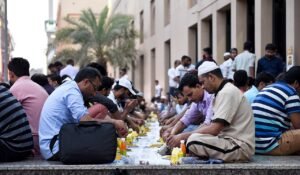
Like the Spring Festival, the Mid-Autumn Festival is a time for families to get together for a festive dinner.
Moon Gazing
After dinner, families go outside to admire the full moon, often while eating mooncakes and fruit and drinking tea. Parks, rooftops and riversides fill with people enjoying the view.
Lanterns
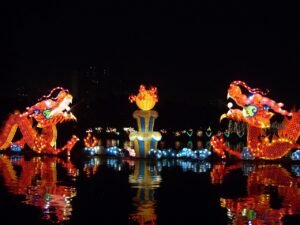
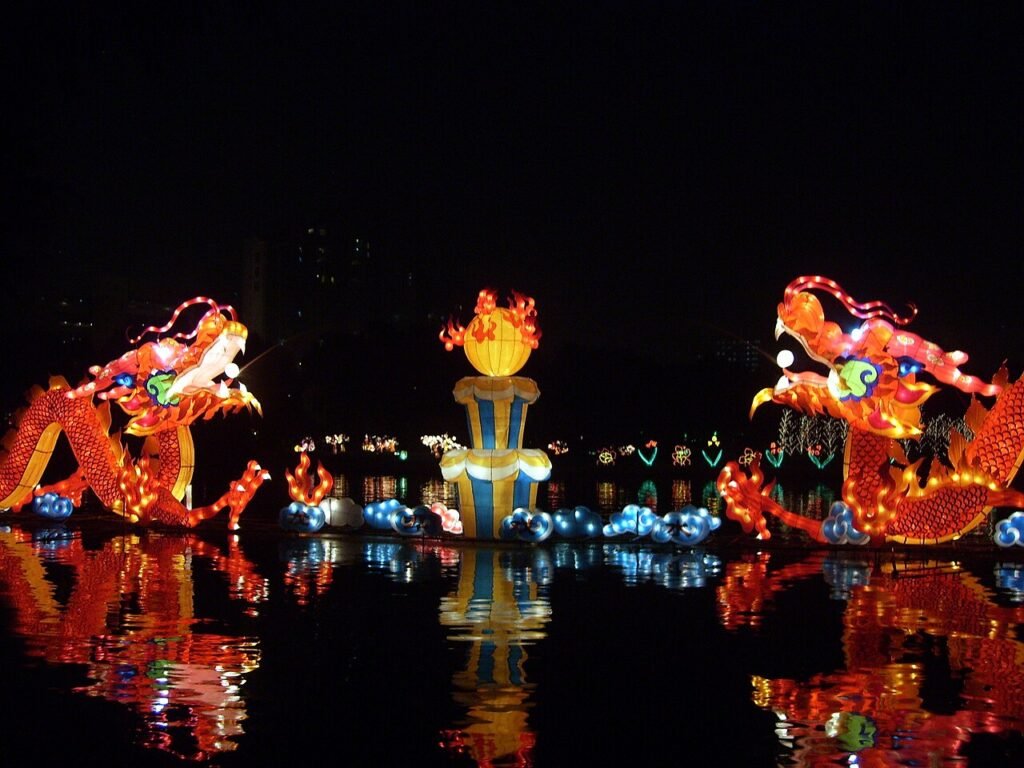
Children carry lanterns of all shapes: rabbits, butterflies, fish, stars, carp and modern designs. In some places, people write wishes or riddles on lanterns or release floating lanterns on rivers. Large lantern displays light up public parks, especially in cities like Hong Kong, Guangzhou and Singapore.
Fire Dragon Dance
In the Tai Hang neighborhood of Hong Kong, people perform a dramatic Fire Dragon Dance, carrying a long dragon made of straw and covered with thousands of burning incense sticks through the streets. The tradition began in the 1800s and is believed to have stopped a plague.
The Mid-Autumn Festival Across Asia
Many other cultures celebrate a harvest moon festival around the same time:
- Korea: Chuseok, a major holiday when families honor their ancestors and eat songpyeon, half-moon-shaped rice cakes.
- Vietnam: Tết Trung Thu, a festival focused especially on children, with lion dances, lanterns and mooncakes.
- Japan: Tsukimi, or moon viewing, with offerings of rice dumplings and pampas grass.
Chang’e Goes to Space
Chang’e’s story has inspired modern science too. China named its lunar exploration program the Chang’e program. In 2019, the Chang’e 4 mission became the first spacecraft to make a soft landing on the far side of the Moon. The rovers from these missions were named Yutu, after the Jade Rabbit. In 2024, the Chang’e 6 mission brought back the first samples ever collected from the Moon’s far side.
Fun Facts for Kids
- Some mooncakes contain four egg yolks, representing the four phases of the moon.
- The full moon of the Mid-Autumn Festival is close to the autumn equinox and is sometimes called the “harvest moon.”
- A famous poem by the Tang dynasty poet Li Bai describes seeing moonlight on the floor and thinking of home, and Chinese children often learn it by heart.
Discussion Questions for Parents and Teachers
- Why do you think the full moon became a symbol of family reunion?
- What does the story of the Jade Rabbit teach about kindness?
- If you designed a mooncake, what filling and symbol would you choose?
- How do people in your culture celebrate the harvest?
Conclusion
The Mid-Autumn Festival is a celebration of the harvest, the beauty of the full moon and, above all, the warmth of family. Under the same bright moon, families share mooncakes, children carry glowing lanterns and grandparents tell stories of Chang’e and the Jade Rabbit. Even when loved ones are far apart, they can look up at the same moon and feel connected. Zhōngqiū kuàilè! Happy Mid-Autumn Festival!
Image: Shizhao / Wikimedia Commons (CC BY-SA 2.5)
✍️ Have a story or article to share? Submit it for review and get published on Srikaram.org.