Image: <a href="https://commons.wikimedia.org/wiki/File:Our_(Almost_Traditional)_Thanksgiving_Dinner.jpg" rel="nofollow noopener" target="_blank">Ms Jones from California, USA / Wikimedia Commons</a> (CC BY 2.0)
Every year on the fourth Thursday of November, kitchens across the United States fill with the smell of roasting turkey, cinnamon and warm bread. Grandparents travel across the country, cousins squeeze around extra tables, and someone almost always asks everyone to share one thing they are thankful for. Thanksgiving is one of the most loved holidays in America, and unlike many celebrations, it is not tied to a single religion. It belongs to everyone who wants to pause, gather and say “thank you.”
In this guide, we will explore where Thanksgiving came from, how it became a national holiday, the foods families serve, and the traditions that make the day special. We will also look honestly at how Native American communities view the holiday, because understanding a culture means hearing all of its voices.
The Harvest Feast of 1621
The story most American children learn begins in 1621 in Plymouth, in what is now Massachusetts. A year earlier, a group of English settlers known as the Pilgrims had crossed the Atlantic Ocean on a ship called the Mayflower. Their first winter was brutal. Nearly half of the passengers died from cold, hunger and illness.
The survivors received help from the Wampanoag people, who had lived on that land for thousands of years. A Patuxet man named Tisquantum, often called Squanto, spoke English and showed the newcomers how to plant corn, catch fish and find local foods. In the autumn of 1621, after a successful harvest, the Pilgrims held a celebration that lasted about three days. Around ninety Wampanoag men, led by the leader Massasoit, joined the gathering.
Historians believe the menu looked quite different from a modern Thanksgiving table. There were probably deer (venison), wild birds such as ducks and geese, fish, shellfish, corn and squash. There were no pumpkin pies, because the settlers had no ovens for baking and very little sugar.
How Thanksgiving Became a National Holiday
For more than two hundred years after 1621, “days of thanksgiving” were held here and there, usually announced by local leaders after a good harvest or a victory. There was no single national date.
That changed thanks to a determined writer named Sarah Josepha Hale. She was a magazine editor (and the author of the nursery rhyme “Mary Had a Little Lamb”). For about seventeen years, Hale wrote letters to presidents and published editorials asking for one shared national day of thanks. In 1863, during the Civil War, President Abraham Lincoln agreed. He proclaimed the last Thursday of November as a national day of Thanksgiving, hoping it would help heal a divided country.
In 1939, President Franklin D. Roosevelt moved the holiday one week earlier to give stores a longer shopping season during hard economic times. People argued about it so much that some families celebrated on two different Thursdays. In 1941, Congress settled the matter by law: Thanksgiving would be held on the fourth Thursday of November, as it still is today.
The Classic Thanksgiving Menu
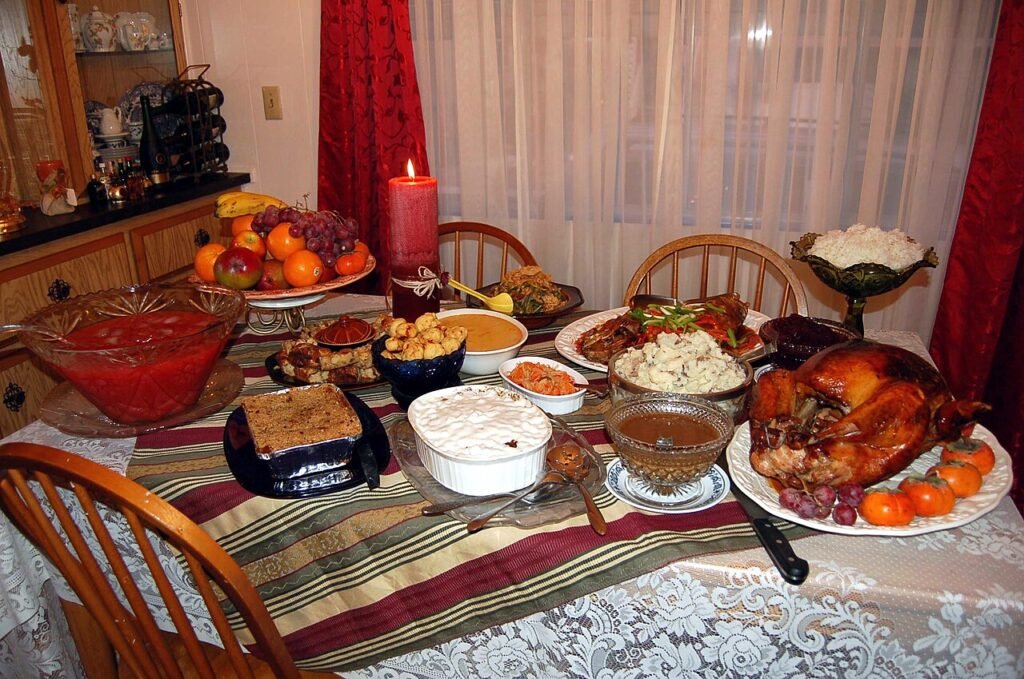
Food is at the heart of the holiday. While every family has its own twist, a “traditional” Thanksgiving dinner often includes:
- Roast turkey, usually the centerpiece, sometimes weighing twenty pounds or more.
- Stuffing or dressing, made from bread cubes, celery, onions and herbs.
- Mashed potatoes and gravy, made from the turkey’s juices.
- Cranberry sauce, sometimes homemade, sometimes from a can with the ridges still showing.
- Sweet potatoes, often baked with brown sugar or topped with marshmallows.
- Green bean casserole, a dish invented in 1955 that became a national favorite.
- Cornbread or dinner rolls.
- Pies, especially pumpkin, apple and pecan.
Because America is a nation of immigrants, Thanksgiving tables also reflect many cultures. An Indian American family might serve tandoori-spiced turkey alongside biryani. A Mexican American family might add tamales. A Chinese American family might include dumplings or sticky rice stuffing. These mixed menus show how the holiday has grown to welcome everyone.
Traditions Beyond the Table
The Macy’s Thanksgiving Day Parade
Since 1924, the Macy’s department store has hosted a famous parade in New York City. Millions of people watch on television as giant helium balloons shaped like cartoon characters float between the skyscrapers. Marching bands, dancers and decorated floats fill the streets, and the parade ends with the arrival of Santa Claus, which signals the start of the holiday season.
Football
For many families, Thanksgiving afternoon means American football. Professional games have been played on Thanksgiving since the 1920s, and teams in Detroit and Dallas host games almost every year. In neighborhoods everywhere, families also play friendly “turkey bowl” games in the backyard before dinner.
The Turkey Pardon
Every year, the President of the United States “pardons” a turkey at the White House, sparing it from becoming dinner. The pardoned birds are sent to live on a farm. It is a lighthearted tradition that children especially enjoy.
Giving Back
Thanksgiving is also a day of service. Many families volunteer at food banks, serve meals at shelters, or donate canned goods. Schools often organize food drives in November. These acts remind children that gratitude means more than words; it means sharing.
The Gratitude Circle
Perhaps the simplest tradition is the most meaningful. Before eating, families go around the table and each person names something they are grateful for. Some families write their answers on paper leaves and attach them to a “gratitude tree.”
A Day of Mourning: Native American Perspectives
For many Native Americans, Thanksgiving brings mixed feelings. The arrival of European settlers led to centuries of land loss, disease and broken treaties for Indigenous peoples. Since 1970, some Native Americans and their supporters have gathered in Plymouth on Thanksgiving Day for a National Day of Mourning, remembering their ancestors and calling attention to ongoing challenges.
This does not mean families cannot enjoy Thanksgiving. But it is a good reminder for children that history is complex. Many teachers now encourage students to learn about the Wampanoag Nation, which still exists today, and to understand the holiday from more than one point of view.
Thanksgiving Around the World
The United States is not the only country with a harvest thanksgiving. Canada celebrates Thanksgiving on the second Monday of October, earlier because its harvest comes sooner in the colder north. Many cultures have their own harvest festivals, such as Pongal and Makar Sankranti in India, Chuseok in Korea, and the Mid-Autumn Festival in China. Each shares the same simple idea: be thankful for food, family and the earth that provides.
Fun Facts for Kids
- Benjamin Franklin once wrote that the turkey was a more respectable bird than the bald eagle.
- Wild turkeys can fly, and they can run up to about twenty-five miles per hour.
- The day after Thanksgiving, called “Black Friday,” is one of the busiest shopping days of the year.
- Americans eat tens of millions of turkeys at Thanksgiving each year.
- The first Macy’s parade had live animals from the Central Park Zoo instead of balloons.
Discussion Questions for Parents and Teachers
- Why do you think Sarah Josepha Hale worked so hard to create a national holiday?
- How might the Wampanoag people have felt about the arrival of the Pilgrims?
- What foods would you add to your family’s Thanksgiving table to represent your culture?
- What is one thing you are grateful for that you cannot see or touch?
- How can your family give back to others during the holiday season?
Frequently Asked Questions
When is Thanksgiving celebrated in the United States? Thanksgiving is celebrated on the fourth Thursday of November every year. The date changes, but it always falls between November 22 and November 28.
Is Thanksgiving a religious holiday? No. Although early days of thanksgiving often included prayer, the modern holiday is a national celebration open to people of all faiths and backgrounds.
Why do Americans eat turkey on Thanksgiving? Turkeys are native to North America, were plentiful, and were large enough to feed a big family. By the 1800s, turkey had become the expected centerpiece.
Conclusion
Thanksgiving has changed a great deal since a small harvest gathering in 1621. It has grown into a national holiday full of parades, football, pies and crowded dinner tables. Yet its core message has stayed the same: take time to notice the good things in your life and share them with others. Whether your family serves turkey or tofu, pumpkin pie or gulab jamun, the most important ingredient is gratitude.
Image: Ms Jones from California, USA / Wikimedia Commons (CC BY 2.0)
✍️ Have a story or article to share? Submit it for review and get published on Srikaram.org.