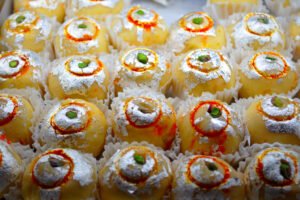
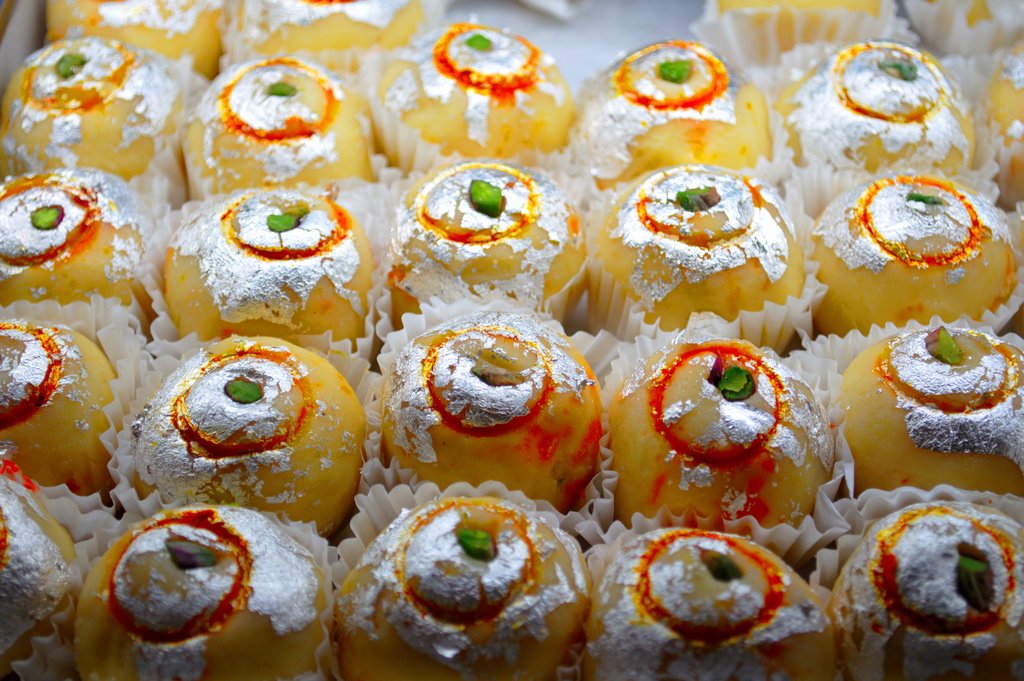
Image: <a href="https://commons.wikimedia.org/wiki/File:Indian_Sweets_Vark.jpg" rel="nofollow noopener" target="_blank">Ian Muttoo / Wikimedia Commons</a> (CC BY-SA 2.0)
Telugu festivals, weddings, and family gatherings are never complete without sweets. From paper-thin wafers to syrupy fried treats, the Telugu states have a delicious variety of traditional sweets, many linked to specific towns and festivals.
Here is a guide to the most famous traditional Telugu sweets.
Pootharekulu (పూతరేకులు)
Perhaps the most unique of all, Pootharekulu means “coated sheets.” They are made from incredibly thin, paper-like sheets of rice starch, layered with powdered sugar or jaggery and ghee, and folded into delicate rolls. Atreyapuram in the Godavari region is especially famous for them, and making the sheets requires great skill on a special heated pot.
Kakinada Kaja (కాకినాడ కాజా)
From the coastal town of Kakinada, this sweet is made from layered dough that is fried and soaked in sugar syrup. The famous gottam kaja is juicy inside, releasing sweet syrup with every bite.
Bandar Laddu (బందరు లడ్డు)
From Machilipatnam (historically called Bandar), this laddu is made from chickpea flour (besan), sugar or jaggery, and ghee, and is known for its rich, melt-in-the-mouth texture.
Ariselu (అరిసెలు)
A must-have for Sankranti, ariselu are made from soaked rice flour and jaggery syrup, shaped into discs, often coated with sesame seeds, and fried. Making them is a family event that takes skill and patience.
Bobbatlu / Polelu (బొబ్బట్లు)
Sweet flatbreads stuffed with a filling of cooked chana dal and jaggery, flavoured with cardamom, and cooked with ghee. Bobbatlu are popular at Ugadi and many other festivals.
Sunnundalu (సున్నుండలు)
Healthy and simple laddus made from roasted urad dal flour, jaggery or sugar, and ghee. They’re rich in protein and often given to growing children and new mothers.
Kajjikayalu (కజ్జికాయలు)
Crescent-shaped fried pastries filled with coconut, jaggery or sugar, and sometimes semolina and dry fruits. A favourite at Deepavali.
Chalividi (చలివిడి)
A traditional sweet made from rice flour, jaggery, and coconut, often prepared as an offering during festivals like Bonalu and Sankranti.
Payasam / Paramannam (పాయసం / పరమాన్నం)
Rice, vermicelli, or dal cooked in milk and sweetened with sugar or jaggery. It is the most common festival sweet and an essential offering at pooja.
Hyderabadi Sweets
Telangana’s capital adds its own royal flavours:
- Double ka Meetha: Bread pudding soaked in saffron-flavoured milk and garnished with nuts.
- Qubani ka Meetha: A dessert of stewed dried apricots, often served with cream.
Sweets and Their Festivals
- Sankranti: Ariselu, nuvvula undalu, chakkera pongali
- Ugadi: Bobbatlu, payasam
- Vinayaka Chavithi: Undrallu, kudumulu
- Deepavali: Kajjikayalu, laddus
- Weddings: Kaja, laddus, pootharekulu
Making Sweets With Kids
Children can help with simple tasks: rolling laddus, measuring ingredients, or pressing sesame seeds onto ariselu. Always keep them away from hot oil and syrup, and supervise closely.
Final Thoughts
Traditional Telugu sweets are edible memories: of festivals, grandmothers’ kitchens, and famous towns along the coast and beyond. Sharing them, and the stories behind them, is a sweet way to pass on Telugu heritage.
You May Also Enjoy
- Why Teaching Your Child Their Mother Tongue Boosts Their Overall IQ
- Is Ram Setu Real? Exploring the Myth, History, and Science Behind the Sacred Bridge
- Aryan vs Dravidian Theory: Understanding the Historical and Cultural Debate
More: World History & Culture · Stories in 14 languages · Srikaram home
Image: Ian Muttoo / Wikimedia Commons (CC BY-SA 2.0)
✍️ Have a story or article to share? Submit it for review and get published on Srikaram.org.