Image: <a href="https://commons.wikimedia.org/wiki/File:Pyramids_of_the_Giza_Necropolis.jpg" rel="nofollow noopener" target="_blank">KennyOMG / Wikimedia Commons</a> (CC BY-SA 4.0)
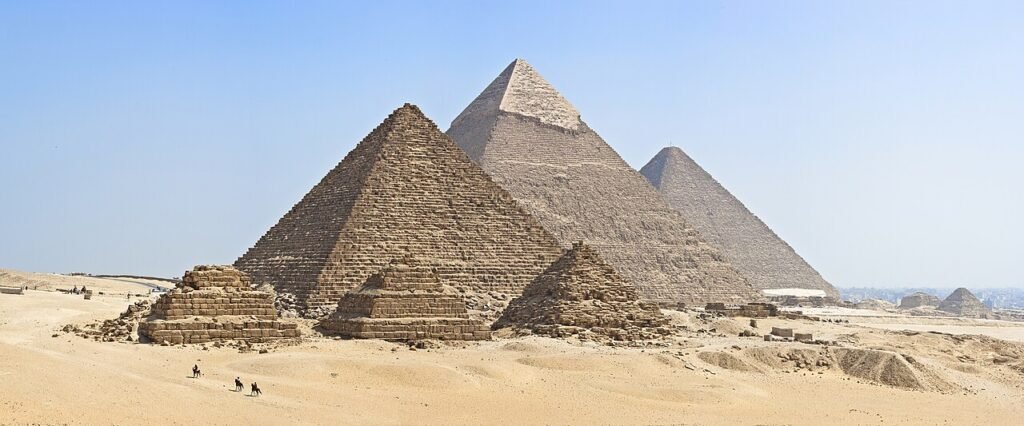
On the edge of the desert, just outside the busy city of Cairo, three enormous stone shapes rise toward the sky. They have stood there for about 4,500 years, older than the Roman Empire, older than the Great Wall of China, older than almost any other building still standing on Earth. These are the Pyramids of Giza, the most famous monuments of ancient Egypt and the only one of the Seven Wonders of the Ancient World that still survives.
The pyramids have fascinated people for thousands of years. How were they built without modern machines? Who built them? Why? In this article, we will explore the answers that archaeologists have discovered, meet the Great Sphinx, learn a little about hieroglyphs, and discover what daily life was like for the people of ancient Egypt.
A Civilization Along the Nile
Ancient Egypt grew along the banks of the Nile River, which flows north through the desert into the Mediterranean Sea. Every year, the Nile flooded, leaving behind rich, black soil perfect for farming. This allowed Egyptians to grow plenty of wheat, barley, vegetables and flax. With a reliable food supply, their civilization flourished for about three thousand years.
Egypt was ruled by kings called pharaohs. Egyptians believed the pharaoh was a link between the gods and the people, responsible for keeping order, called ma’at, in the world. Historians divide ancient Egyptian history into periods: the Old Kingdom (the age of the great pyramids), the Middle Kingdom and the New Kingdom (the age of famous pharaohs like Tutankhamun and Ramesses II).
Why Build Pyramids?
The pyramids were tombs for pharaohs. Ancient Egyptians believed strongly in an afterlife, a life that continued after death. They believed that a person’s spirit needed a preserved body and a protected resting place, along with food, objects and treasures, to live on happily in the next world.
Early tombs were flat, rectangular structures called mastabas. Around 2650 BCE, an architect named Imhotep designed a tomb for Pharaoh Djoser by stacking six mastabas on top of each other, creating the Step Pyramid at Saqqara, one of the first large stone buildings in the world. Later builders learned to make the smooth-sided pyramids that we picture today.
The pyramid shape may have represented the rays of the sun spreading down to Earth, or the mound of land that Egyptians believed rose from the waters at the beginning of creation. Either way, it was a symbol of power and eternity.
The Three Great Pyramids of Giza
The Great Pyramid of Khufu
The largest pyramid was built for Pharaoh Khufu (also called Cheops) around 2560 BCE. When it was finished, it stood about 146 meters (481 feet) tall, and it remained the tallest human-made structure in the world for nearly four thousand years. Today it is a little shorter, about 138 meters, because its smooth outer layer of white limestone was removed over the centuries and its top stones are missing.
The Great Pyramid is made of an estimated 2.3 million stone blocks. Most weigh a couple of tons, but some granite blocks inside weigh many tons more. Its sides are aligned almost perfectly with the four directions of the compass: north, south, east and west. Inside are narrow passages, a tall, sloping corridor called the Grand Gallery, and the King’s Chamber, made of red granite.
The Pyramids of Khafre and Menkaure
Next to it stands the pyramid of Khafre, Khufu’s son. It looks taller because it sits on higher ground, and some of its original smooth casing stones remain near the top. The third and smallest pyramid belongs to Menkaure. Around these three are smaller pyramids for queens, temples and many tombs for nobles and officials.
How Were the Pyramids Built?
Building the Great Pyramid probably took about twenty years. There is still debate about exact methods, but archaeologists have learned a great deal.
- Quarrying: Workers cut limestone blocks from quarries near Giza, using copper chisels, stone hammers and wooden wedges. Fine white limestone came from Tura, across the river, and granite came from Aswan, hundreds of kilometers to the south.
- Transporting: Heavy stones were moved on wooden sledges. A wall painting from an ancient tomb shows workers pouring water on the sand in front of a sledge, which, scientists have found, makes sand firmer and reduces friction. Boats carried stones along the Nile and canals. In 2013, archaeologists found ancient papyrus logbooks, sometimes called the Diary of Merer, written by an official who transported limestone blocks by boat for the Great Pyramid.
- Lifting: Most experts believe builders used ramps made of mud brick, rubble and limestone chips to drag stones up the pyramid. The ramps may have been straight, zigzagging or wrapped around the pyramid.
- Measuring: Egyptians were skilled at mathematics and astronomy. They used simple tools like ropes, plumb lines and sighting instruments, along with observations of the stars, to create precise angles and directions.
Who Were the Workers?
For a long time, many people believed the pyramids were built by slaves. However, archaeologists have discovered a workers’ village near Giza with bakeries, breweries, houses and cemeteries. The workers’ tombs were placed respectfully near the pharaoh’s pyramid, which would not have been allowed for slaves. Skeletons show that injured workers received medical care, including set broken bones.
Experts now believe the pyramids were built by paid laborers and skilled craftsmen, possibly thousands of them, including farmers who worked during the flood season when their fields were underwater. Teams of workers even left graffiti with funny team names, such as “Friends of Khufu.”
The Great Sphinx
Near the pyramid of Khafre lies the Great Sphinx, a giant statue with the body of a lion and the head of a human, probably carved to represent Pharaoh Khafre. It is about 73 meters long and 20 meters high, carved directly from the limestone bedrock. The Sphinx seems to guard the pyramids, facing the rising sun.
Its nose is missing. Stories once blamed cannonballs fired by Napoleon’s soldiers, but drawings made before Napoleon’s time already show the Sphinx without a nose. Historical accounts suggest it was deliberately damaged centuries earlier.
Mummies and the Journey to the Afterlife
To preserve bodies for the afterlife, Egyptians developed mummification. Specialized priests removed internal organs, dried the body with a natural salt called natron, and wrapped it in hundreds of meters of linen bandages. Organs were stored in special containers called canopic jars. Protective amulets were placed among the wrappings. The whole process could take seventy days.
Tombs were filled with things the person might need in the afterlife: furniture, clothing, jewelry, food, games and small figures called shabtis, meant to do work on the person’s behalf. Walls were decorated with paintings and spells from texts such as the Book of the Dead, a guide to help the spirit pass safely through the underworld.
Hieroglyphs: The Sacred Writing
Ancient Egyptians wrote using hieroglyphs, a writing system of hundreds of picture symbols. Some symbols stood for sounds, some for whole words, and some gave clues about meaning. Hieroglyphs were carved on temple walls, tombs and monuments, while scribes used simpler scripts on papyrus, an early form of paper made from reeds.
For centuries after ancient Egypt ended, no one could read hieroglyphs. Then, in 1799, soldiers in Napoleon’s army discovered the Rosetta Stone, a slab with the same message written in hieroglyphs, a script called Demotic and ancient Greek. Because scholars could read Greek, they had a key. In 1822, the French scholar Jean-François Champollion announced that he had cracked the code. Suddenly, the voices of ancient Egyptians could be heard again.
Daily Life in Ancient Egypt
Not everyone in ancient Egypt was a pharaoh or priest. Most people were farmers. Others were bakers, potters, weavers, carpenters, jewelers, fishermen, soldiers and scribes.
- Food: Bread and a thick drink made from barley were basic foods. People also ate onions, garlic, lentils, beans, fish, dates, figs and honey.
- Homes: Most houses were made of mud bricks, which kept them cool. Families often slept on the flat roofs during hot nights.
- Clothing: Most people wore light linen clothing. Both men and women wore eye makeup, called kohl, which also protected their eyes from the sun.
- Children: Kids played with balls, dolls, spinning tops and board games. A popular game was senet, a board game played with game pieces and throwing sticks.
- Pets: Egyptians loved cats, dogs and monkeys. Cats were especially honored and were linked with the goddess Bastet.
Women in ancient Egypt had more rights than in many ancient societies. They could own property, run businesses and represent themselves in court. Some women even became pharaohs, such as Hatshepsut.
Visiting Giza Today
Today, the Giza Plateau is a UNESCO World Heritage Site, part of the “Memphis and its Necropolis” area listed in 1979. Visitors can walk around the pyramids, ride camels across the desert, and see the Sphinx up close. Nearby, the huge Grand Egyptian Museum displays treasures from ancient Egypt, including many objects from the tomb of Tutankhamun. At night, sound and light shows tell the story of the pharaohs.
Fun Facts for Kids
- The Great Pyramid was originally covered in polished white limestone, so it would have gleamed brightly in the sun.
- Ancient Egyptians invented one of the earliest calendars with 365 days.
- The Great Pyramid was already ancient in Cleopatra’s time. In fact, she lived closer in time to the Moon landing than to the building of the Great Pyramid.
Discussion Questions for Parents and Teachers
- Why did ancient Egyptians put so much effort into building tombs?
- What evidence shows that the pyramid builders were paid workers, not slaves?
- How did the Rosetta Stone help people read hieroglyphs?
- Which part of daily life in ancient Egypt seems most like life today?
Conclusion
The Pyramids of Giza are more than giant piles of stone. They are a testament to the skill, organization, faith and teamwork of an extraordinary civilization. Built by thousands of workers along the banks of the Nile, they continue to amaze us with their size and precision. Every block tells a story of people who dreamed of eternity and, in a way, achieved it, because we still remember them today.
Image: KennyOMG / Wikimedia Commons (CC BY-SA 4.0)
✍️ Have a story or article to share? Submit it for review and get published on Srikaram.org.