Image: <a href="https://commons.wikimedia.org/wiki/File:Samba_de_Roda_do_Rec%C3%B4ncavo_-_Bahia_-_3909_005.jpg" rel="nofollow noopener" target="_blank">Maria Eugenia Tita / Wikimedia Commons</a> (CC BY 4.0)
For several days every year, the whole of Brazil seems to dance. In Rio de Janeiro, glittering floats as tall as buildings roll through a stadium while thousands of dancers in feathers and sequins move to the pounding beat of drums. In Salvador, enormous trucks carrying live bands crawl through the streets, followed by crowds that stretch for miles. In the hillside town of Olinda, giant puppets twice the height of a person sway above happy crowds. This is Carnaval, Brazil’s most famous festival and often described as the biggest party on Earth.
Carnival is a celebration of music, creativity, community and joy. But it is also a window into Brazil’s history, a story of European, African and Indigenous cultures blending together. In this article, we will explore where Carnival came from, how it is celebrated in different parts of Brazil, and why samba is at its heart.
When Is Carnival?
Carnival takes place in the days just before Lent, the forty-day period of reflection that Christians observe before Easter. Its date changes each year but usually falls in February or early March. The main celebrations run from Friday until Ash Wednesday, when Lent begins.
The word carnival is often traced to the Latin or Italian phrase meaning “farewell to meat,” because traditionally people gave up eating meat during Lent. Carnival was the last chance to feast and celebrate before the quieter season.
A Mix of Cultures
Carnival came to Brazil with the Portuguese, who colonized the country beginning in 1500. They brought a rowdy tradition called entrudo, in which people threw water, flour, mud and even eggs at each other in the streets. Later, in the 1800s, wealthy Brazilians copied the elegant masked balls of Paris and Venice.
But the most important influences on modern Brazilian Carnival came from Afro-Brazilians. Millions of Africans were brought to Brazil in chains during the centuries of slavery, more than to any other country in the Americas. They and their descendants kept alive African rhythms, dances, religious traditions and community gatherings. Brazil abolished slavery in 1888, the last country in the Americas to do so. In the years that followed, Afro-Brazilian communities, especially in Rio de Janeiro and Salvador, shaped Carnival into the celebration we know today.
Indigenous Brazilian cultures have also influenced Carnival costumes, themes and music, and many parades honor Indigenous history and Brazil’s natural environment.
Samba: The Heartbeat of Carnival
Samba is the music and dance most closely linked to Brazil. It developed in the early 1900s in Rio de Janeiro, especially in neighborhoods where many Afro-Brazilians lived, including families who had moved from the state of Bahia. Gatherings in the homes of community elders, such as the famous Tia Ciata, became places where musicians created new sounds.
In 1917, a song called “Pelo Telefone” became one of the first recorded songs to be labeled a samba, and it was a huge hit.
Samba has a fast, rolling rhythm, usually in 2/4 time, driven by percussion instruments, including:
- Surdo: A large bass drum that keeps the steady heartbeat.
- Tamborim: A small, high-pitched frame drum played with a stick.
- Caixa: A snare drum.
- Repinique: A drum that often leads and signals changes.
- Cuíca: A friction drum that makes a funny squeaking or laughing sound.
- Agogô: A double bell.
- Pandeiro: A tambourine-like frame drum.
- Cavaquinho: A small four-stringed guitar.
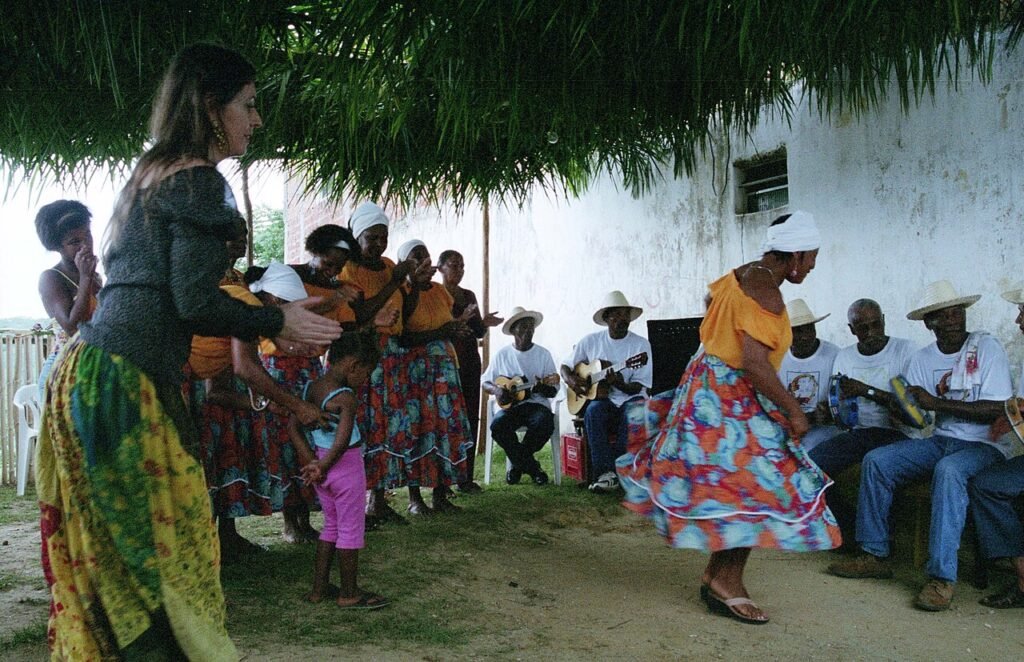
Samba dancing involves quick footwork, swaying hips and joyful energy. In 2005, UNESCO recognized the Samba de Roda of Bahia, a traditional form of samba danced in a circle, as a Masterpiece of the Oral and Intangible Heritage of Humanity.
Rio de Janeiro: The Samba Schools
Rio’s Carnival is the most famous in the world. Its biggest attraction is the parade of the samba schools (escolas de samba). Despite the name, these are not schools in the usual sense. They are community organizations, often based in working-class neighborhoods, that spend an entire year preparing for Carnival.
Preparing for the Parade
Each samba school chooses a theme, called an enredo, which might be about Brazilian history, a famous person, nature, folklore or a social message. A special samba song, the samba-enredo, is written to tell the story. Artists design spectacular floats and thousands of costumes. Community members, including children and grandparents, rehearse for months.
The Sambadrome
The top samba schools parade in the Sambódromo (Sambadrome), a long avenue lined with grandstands, designed by the famous Brazilian architect Oscar Niemeyer and opened in 1984. Tens of thousands of spectators watch each night.
Each school has a set time, usually more than an hour, to parade through the Sambadrome. A school can include several thousand participants, organized into sections called alas, each with its own costumes. Highlights include:
- The bateria: A drum section that may have hundreds of percussionists playing in perfect unison.
- The comissão de frente: The front commission, a group that opens the parade with a dramatic performance.
- The mestre-sala and porta-bandeira: A couple who dance gracefully while carrying and protecting the school’s flag.
- The baianas: Older women dressed in wide, spinning skirts, honoring the women from Bahia who helped create samba.
- The floats (carros alegóricos): Massive, moving sculptures that may include fountains, lights and dancers.
Judges score each school on categories such as music, costumes, floats, rhythm and storytelling. The winning school is announced after Carnival, and its neighborhood erupts in celebration.
Street Parties
Not all of Rio’s Carnival happens in the Sambadrome. Hundreds of free street parties called blocos take place across the city. Some blocos have small bands; others draw more than a million people. Many have funny names and themes, and people dress up in creative homemade costumes.
Salvador: The Trio Elétrico
In Salvador, the capital of the state of Bahia, Carnival has a different flavor. Salvador is often called the center of Afro-Brazilian culture, and its Carnival reflects that strongly.
The star of Salvador’s Carnival is the trio elétrico, a huge truck fitted with powerful speakers and a stage on top, carrying live musicians. The idea was invented in 1950 by two musicians, Dodô and Osmar, who played electric guitars on top of an old car. Today, trios elétricos move slowly through the streets while huge crowds dance behind them.
Salvador is also known for blocos afro, groups that celebrate African heritage through music, dance and costumes. One of the most famous is Olodum, known for its powerful drumming. Another is Ilê Aiyê, founded in 1974. Music styles such as axé and samba-reggae are popular here.
Recife and Olinda: Frevo and Giant Puppets
In the northeastern state of Pernambuco, the cities of Recife and Olinda have their own Carnival traditions.
Frevo
Frevo is a fast, energetic music and dance style. Its name comes from the Portuguese word ferver, meaning “to boil.” Dancers leap, kick and squat, holding small, colorful umbrellas for balance. Brass bands play rapid, exciting tunes. UNESCO recognized frevo as Intangible Cultural Heritage in 2012.
Maracatu
Maracatu is a traditional procession with deep African roots, featuring heavy drumming and royal characters such as a king and queen, recalling coronations of Black kings and queens during colonial times.
The Giant Puppets
In the colorful colonial town of Olinda, Carnival features bonecos gigantes, giant puppets made of papier-mâché and fabric, often three meters or more tall. Performers wear them and dance through the steep, cobbled streets. The puppets often represent famous Brazilians, politicians, artists and local characters.
Carnival Costumes and Creativity
Brazilian Carnival costumes, called fantasias, can be extraordinary, with feathers, beads, sequins and huge headdresses. But many people also make simple, funny costumes at home. Children often wear masks, superhero outfits, or dress as animals. Glitter and confetti are everywhere.
Carnival for Kids
Many cities hold special children’s blocos, with gentle music, games and costume contests during the daytime. Families can enjoy the fun safely, dancing and singing traditional marchinhas, simple, catchy Carnival songs that everyone knows.
Fun Facts for Kids
- Rio’s Carnival attracts millions of people every year, including visitors from all over the world.
- A single float in Rio can be more than ten meters high.
- Many samba school members spend all year preparing for a parade that lasts just over an hour.
Discussion Questions for Parents and Teachers
- How do you think Afro-Brazilian communities shaped Carnival into what it is today?
- Why might a whole neighborhood work all year on a single parade?
- If your community had a samba school, what theme would you choose for your parade?
- How is Carnival similar to other festivals you know, like Mardi Gras in New Orleans?
Conclusion
Brazilian Carnival is a brilliant celebration of music, history and togetherness. It began with European traditions but grew into something uniquely Brazilian through the creativity of Afro-Brazilian, Indigenous and immigrant communities. Whether it is the thunder of a samba school’s drums, the joyful crowds behind a trio elétrico, or the giant dancing puppets of Olinda, Carnival shows the world the warmth, energy and spirit of Brazil.
Image: Maria Eugenia Tita / Wikimedia Commons (CC BY 4.0)
✍️ Have a story or article to share? Submit it for review and get published on Srikaram.org.