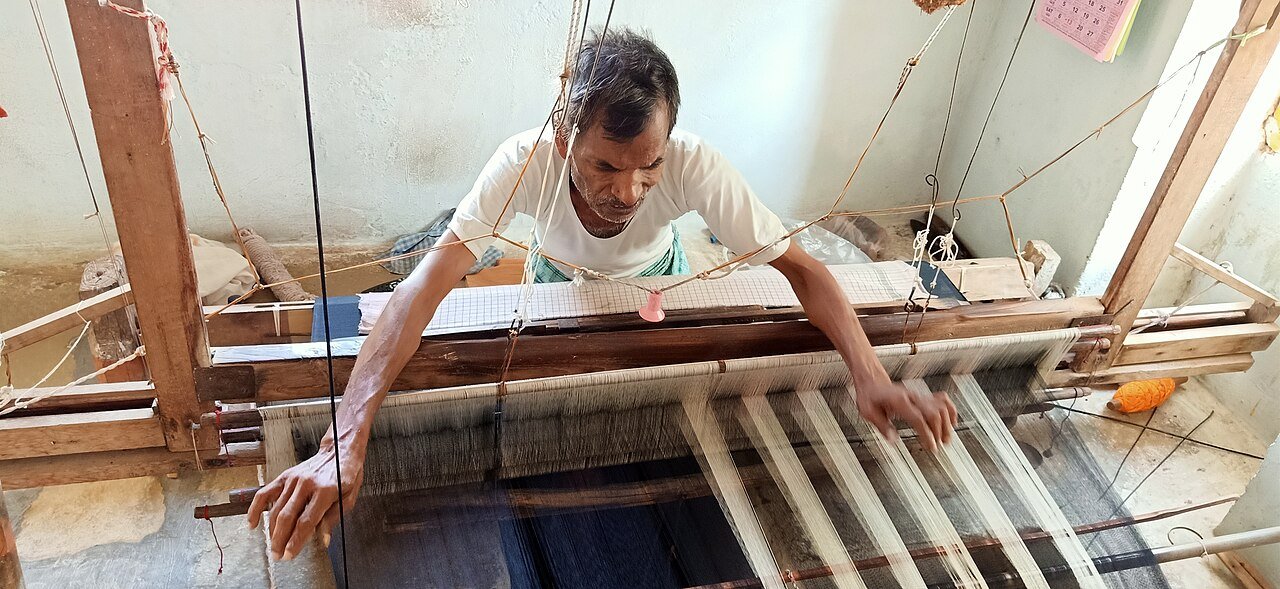
Image: <a href="https://commons.wikimedia.org/wiki/File:Saree_Weaving_by_Handloom_3.jpg" rel="nofollow noopener" target="_blank">Pranayraj1985 / Wikimedia Commons</a> (CC BY-SA 4.0)
The Telugu states are home to some of India’s most beautiful handloom traditions. Each weaving town has its own techniques, patterns, and stories, passed down through generations of weaver families. Many of these sarees carry Geographical Indication (GI) tags that protect their unique identity.
Here is a guide to the famous handloom sarees of Andhra Pradesh and Telangana.
Telangana
Pochampally Ikat From Bhoodan Pochampally and nearby villages in Telangana, Pochampally is famous for ikat, a technique where the threads are tie-dyed before weaving. When woven, the dyed threads create bold geometric patterns with a slightly blurred, dreamy edge. Pochampally has become a symbol of Telangana’s weaving heritage.
Gadwal Sarees Gadwal sarees are known for their cotton body and silk border and pallu, which are woven separately and then joined using a special interlocking technique. The contrast makes them both light and grand, and they are popular for festivals and weddings.
Narayanpet Sarees With simple checks, bold borders, and temple-inspired designs, Narayanpet sarees are loved for their elegance and durability.
Siddipet Gollabhama These cotton sarees feature motifs of the gollabhama, a milkmaid carrying pots, woven into the fabric: a charming, distinctive design.
Andhra Pradesh
Uppada Jamdani From Uppada in the Kakinada region on the east coast, these sarees use the delicate jamdani technique, weaving intricate motifs by hand into light, fine fabric. They are prized for their feather-light feel.
Venkatagiri Sarees From Venkatagiri in the Nellore region, these sarees are known for their very fine cotton, soft texture, and elegant zari borders, historically patronised by local royalty.
Dharmavaram Silk From Dharmavaram in the Anantapur region, these rich silk sarees feature broad borders, heavy gold zari, and contrasting colours, making them a favourite for weddings.
Mangalagiri Cotton From Mangalagiri near Guntur, these cotton sarees are known for their crisp texture, simple elegance, and the distinctive Nizam border, with no woven body designs.
Chirala and Others Chirala and several other towns across the state are also known for handloom cotton and silk weaving.
Why Handloom Matters
- Livelihoods: Handloom supports thousands of weaver families.
- Sustainability: Handloom weaving uses little electricity and often natural fibres.
- Heritage: Every pattern carries history, symbolism, and regional identity.
- Uniqueness: Each handwoven piece has slight variations that make it one of a kind.
Teaching Children About Handloom
- Look at family sarees and dhotis together and find out where they came from.
- Watch a video of a handloom or visit a weavers’ exhibition.
- Try a simple paper weaving craft to understand warp and weft.
- Learn Telugu words: chenetha (handloom), pattu (silk), nooluu (thread).
- Celebrate National Handloom Day on August 7.
Final Thoughts
The handlooms of Andhra Pradesh and Telangana are woven with skill, patience, and centuries of tradition. When we wear, buy, and learn about them, we help keep these beautiful crafts, and the weaving families behind them, thriving.
You May Also Enjoy
- The Physics of the Pushpaka Vimana: Ancient Myth or Early Science?
- The Kakatiya Dynasty: Leadership Lessons from Ancient Warangal
- Why Teaching Your Child Their Mother Tongue Boosts Their Overall IQ
More: World History & Culture · Stories in 14 languages · Srikaram home
Image: Pranayraj1985 / Wikimedia Commons (CC BY-SA 4.0)
✍️ Have a story or article to share? Submit it for review and get published on Srikaram.org.