
The Physics of the Pushpaka Vimana: Ancient Myth or Early Science?
The Physics of the Pushpaka Vimana — The Pushpaka Vimana from the Ramayana: what the texts say, popular claims, what science says, and how to think critically about ancient myths.
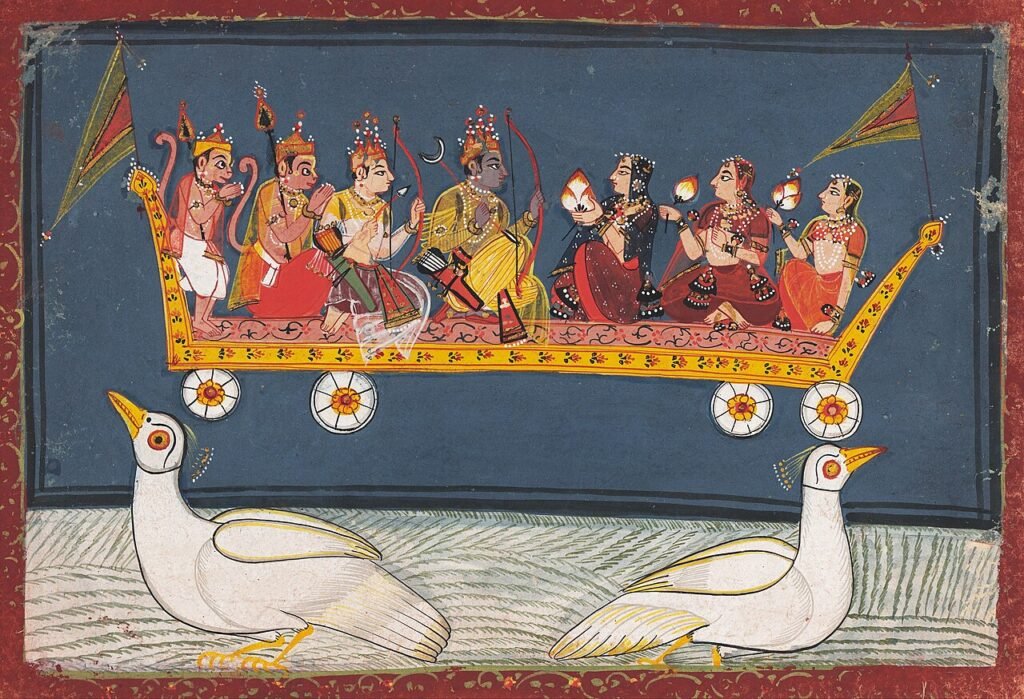
The Pushpaka Vimana — the celestial vehicle that carries Ravana through the sky in the Ramayana — has fascinated scholars, engineers, and mythologists for centuries. In the twentieth century, as aviation became a reality, interest intensified: was the Pushpaka Vimana an elaborate myth, a metaphorical device, or a cultural memory of something the ancient world had actually achieved or theoretically conceived?
The answer is more nuanced and more interesting than either the debunking skeptic or the enthusiastic ancient-technology theorist would have us believe.
What the Texts Actually Say
The Pushpaka Vimana is described across multiple texts — the Valmiki Ramayana, the Mahabharata, and the Arthashastra — in language that is remarkably technical for metaphorical writing. It is described as made of worked metal (not magical cloud or divine substance), capable of moving in multiple directions including vertically, powered by some form of internal mechanism, and large enough to accommodate multiple passengers.
The Vimana Shastra — a text whose dating is disputed, ranging from ancient to medieval — describes the construction of various types of vimanas in detail, including material specifications, propulsion theories, and operational principles. Whether this represents genuine ancient engineering knowledge, medieval speculation dressed in ancient language, or something in between, it is not simple storytelling.
The Physics of Lift: What Would Have Been Required
For a vehicle to achieve sustained flight, it must overcome gravity through lift, generated by either buoyancy (as in balloons) or aerodynamic force (as in aircraft wings). Ancient India had access to the mathematics of forces, the metallurgy for worked metal structures, and a sophisticated understanding of fluid dynamics through water engineering.
What it lacked — so far as current evidence shows — is the energy density required for sustained powered flight. The Vimana texts speak of powered mechanisms, but none has been convincingly reconstructed from the descriptions provided. This is the crux of the scholarly debate: the concept appears to be there; the evidence of execution does not.
The More Interesting Question
Whether the Pushpaka Vimana was a real aircraft or an imagined one, the more historically significant question may be: why were ancient Indian texts obsessing over the details of flying vehicles? What cultural impulse, what theoretical tradition, what conceptual framework was generating these descriptions?
The Vedic tradition was deeply engaged with the physics of the natural world — astronomy, metallurgy, acoustics, mathematics, and fluid dynamics were all areas of serious systematic inquiry. The vimana texts may represent the extension of this rigorous intellectual tradition into speculative engineering: not ‘we built this’ but ‘what would be required to build this, and how would it work?’
This is, structurally, the same intellectual activity as modern theoretical physics — the exploration of what the laws of nature would permit, without necessarily claiming that the thing exists yet.
🔭 Perspective: Leonardo da Vinci designed flying machines in the 15th century that could not have been built with 15th century materials or power sources. This does not make him a fraud or his designs worthless. It makes him a thinker who understood the principles before the materials existed. The Vimana tradition may represent exactly this kind of forward-reaching theoretical intelligence.
“The mythology of a civilization reveals what that civilization dreamed of. A civilization that dreamed of flight — in detail, with physics — was a civilization that understood the world well enough to envision transcending it.”
Related Reading
- Is Ram Setu Real? Exploring the Myth, History, and Science Behind the Sacred Bridge
- The Ramayana – A Summary
- Differences between Mahabharata and Ramayana
More: World History & Culture · Stories in 14 languages · Srikaram home
✍️ Have a story or article to share? Submit it for review and get published on Srikaram.org.