
What the Old Banyan Tree Remembered
What the Old Banyan Tree Remembered — An ancient banyan tree remembers generations of villagers under its branches. A thoughtful banyan tree story about memory, time and community.
The banyan tree at the centre of the village was so old that no one remembered when it had arrived, which suggested it had always been there — which was not true, of course, but felt true in the way that very permanent things feel permanent even when they began.
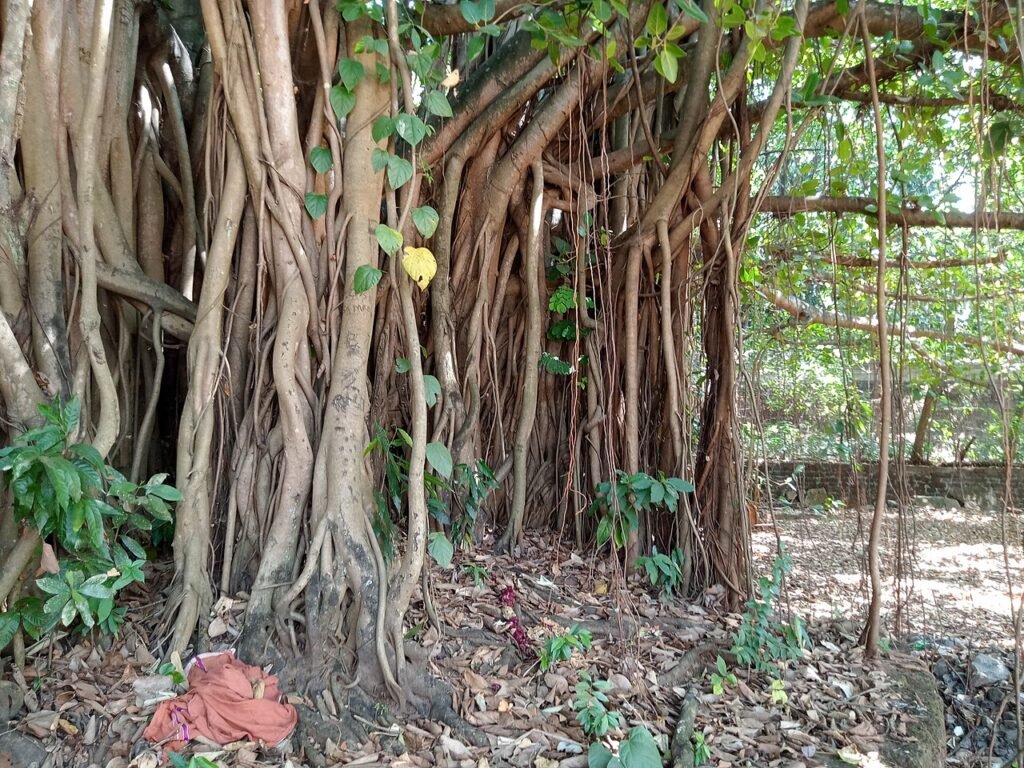
The tree had roots and branches so extensive that they formed a kind of open-air room beneath its canopy. In this room, the village elders met. Problems were brought, stories were told, disputes were heard. For three generations, every significant decision in the village had been made in its shade.
A boy named Suresh, who was eleven, sat under the tree one afternoon with his notebook and a question. He was working on a school project called ‘The History of Our Village,’ and he had run into a problem: all the adults he had asked gave different answers to the same questions. According to his grandmother, the canal was built ‘after the famine.’ According to the village headman, the canal was built ‘before independence.’ According to the oldest farmer in the village, the canal ‘had always been there, like the tree.’
He sat under the tree and wrote in his notebook: ‘How do you know what is true when different people remember different things?’
Then he sat for a while, because there was no one to answer him.
‘The tree knows,’ said a voice.
He looked up. An old woman he did not recognise was sitting on one of the tree’s exposed roots. She was very small and very old and looked like someone who was comfortable sitting in places where she had always sat.
‘Trees don’t know things,’ said Suresh, carefully.
‘Not the way people know things,’ she agreed. ‘But the tree grew during the drought years and those rings will be narrow. It grew during the good monsoon years and those rings will be wide. If you knew how to read them, you would know when the rains failed and when they did not — more accurately than any person’s memory.’
Suresh wrote this in his notebook. Then: ‘But I can’t cut the tree open.’
‘No,’ she said. ‘But you can look for the other records. Soil is a record. Tax documents are a record. Old photographs are records. Every living thing that remembers differently is a record — not of the same thing, but of their experience of the thing. Your grandmother remembers the famine because she was hungry. The headman remembers the political timing because he cares about politics. The farmer remembers that the canal was always there because he was born after it was built.’
Suresh looked at his notes. ‘So none of them are wrong?’
‘They are each wrong in the way that any single witness is wrong — incomplete, shaped by what they were and where they stood. The closer you get to the truth is to put all the witnesses together and look at where they overlap.’
He wrote this down. Then: ‘Who are you?’
The old woman smiled. ‘My father’s father planted this tree,’ she said. ‘I come and sit here sometimes because it is the only thing that was here before I was, and I find that comforting.’
Suresh finished his project the following week. His teacher gave it the highest marks she had ever given a history project. In her comment, she wrote: ‘You understood something that most historians spend careers learning: that truth is not a single story but the place where many stories converge.’
Suresh kept the notebook. Decades later, when he was a historian himself, he used it as the opening example in a lecture he gave every year on the nature of historical evidence. He always credited the source: ‘An old woman under a banyan tree who knew that trees are also witnesses.’
🌟 Moral: A single account of anything is a starting point, not an ending point. The truth lives in the space between different memories, not in any one of them. Learning to hold multiple perspectives simultaneously — without discarding any of them prematurely — is the beginning of genuine understanding.
Related Reading
- Chintu and the Lost Kite: A Sankranti Story for Kids About Letting Go
- The Cobbler’s Wish: A Short Story About Contentment for Kids
- The Lantern Maker’s Daughter: A Deepavali Short Story About Perseverance for Kids
More: World History & Culture · Stories in 14 languages · Srikaram home
✍️ Have a story or article to share? Submit it for review and get published on Srikaram.org.