
The Weaver Who Wove the Seasons
The Weaver Who Wove the Seasons — In the Godavari delta, a silk weaver weaves the seasons into her cloth. A lyrical weaver story about craft, patience and nature for young readers.
In a village in the Godavari delta, where the river ran wide and green and the silk worms were fed on mulberry leaves grown in the courtyard of every third house, there lived a weaver named Balaiah who was the finest craftsman in the region — and the slowest.
His neighbours wove six saris a week. Balaiah wove one, sometimes two. When they asked him why he was so slow, he said only: ‘I am listening to the thread.’
His daughter, Kamala, asked him once what this meant.
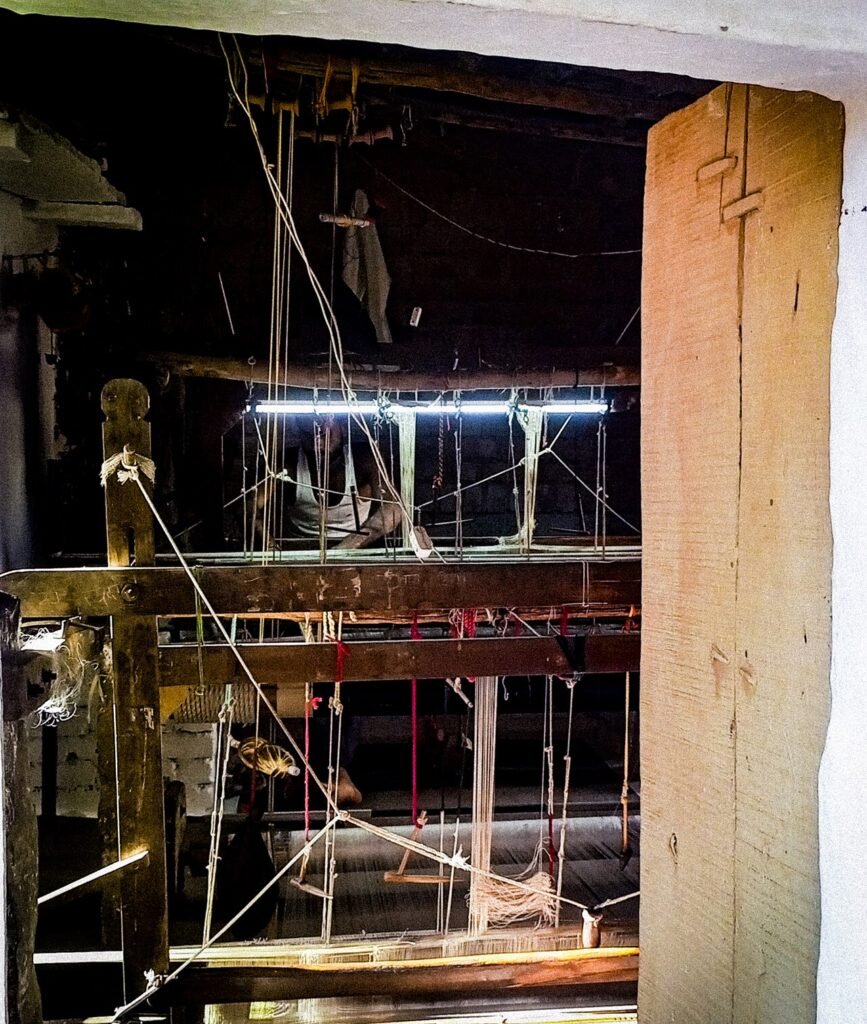
He sat her down at his loom — an old wooden instrument, worn smooth where his hands had touched it for thirty years — and said: ‘Listen.’
She listened. She heard the shuttle moving, the clack of the beater, the rhythmic press of the treadles.
‘That’s the loom,’ she said.
‘Wait,’ he said.
She waited. And then she heard something else, something beneath the mechanical sound: a kind of tension in the threads, a vibration that changed as the pattern changed, that tightened when a colour transition was imprecise and eased when it was right.
‘I hear it,’ she said, surprised.
‘Good,’ he said. ‘Now you understand why I am slow.’
Balaiah’s saris were different from his neighbours’ in ways that buyers could feel but rarely explain. The colours moved into each other rather than stopping, the way seasons move. The patterns had a quality of inevitability — as if they could not have been otherwise — that cheaper, faster work never achieved.
A merchant from Hyderabad came to the village one year, searching for something for a royal family’s wedding. He visited every weaver in the village. He bought one sari, and it was Balaiah’s.
The price he paid was ten times the price of any other sari in the village. Balaiah’s neighbours were outraged by this and by what they felt was luck. They worked faster, they increased their output, they produced more saris in a month than Balaiah produced in a year.
The merchant returned the following year. He bought another of Balaiah’s saris.
Kamala, who was older now and beginning to weave herself, asked her father: ‘Why does he only buy yours?’
‘Because,’ said Balaiah, adjusting a thread with one careful finger, ‘a person who truly knows what they are looking for can always tell the difference between something made with attention and something made with speed. The two things feel different. Not in the hand, necessarily. In some other place — here.’ He touched his chest.
Kamala wove slowly from then on. Her neighbours thought her foolish. Her first sari took six weeks. Her second took five. Her third took four — but only because she had learned, by listening, to move faster without listening less.
Twenty years later, it was her work that a filmmaker from Mumbai chose for a film that would be seen by thirty million people, and her name — and her village’s name — that appeared in the final credits.
She sent her father a clipping of the credit. He kept it next to his loom.
🌟 Moral: Speed without attention produces quantity. Attention produces quality. In a world that rewards output, the person who slows down enough to truly listen to what they are making — and to make it exactly right — will always, eventually, be found.
Related Reading
- Chintu and the Lost Kite: A Sankranti Story for Kids About Letting Go
- The Cobbler’s Wish: A Short Story About Contentment for Kids
- The Lantern Maker’s Daughter: A Deepavali Short Story About Perseverance for Kids
More: World History & Culture · Stories in 14 languages · Srikaram home
✍️ Have a story or article to share? Submit it for review and get published on Srikaram.org.