
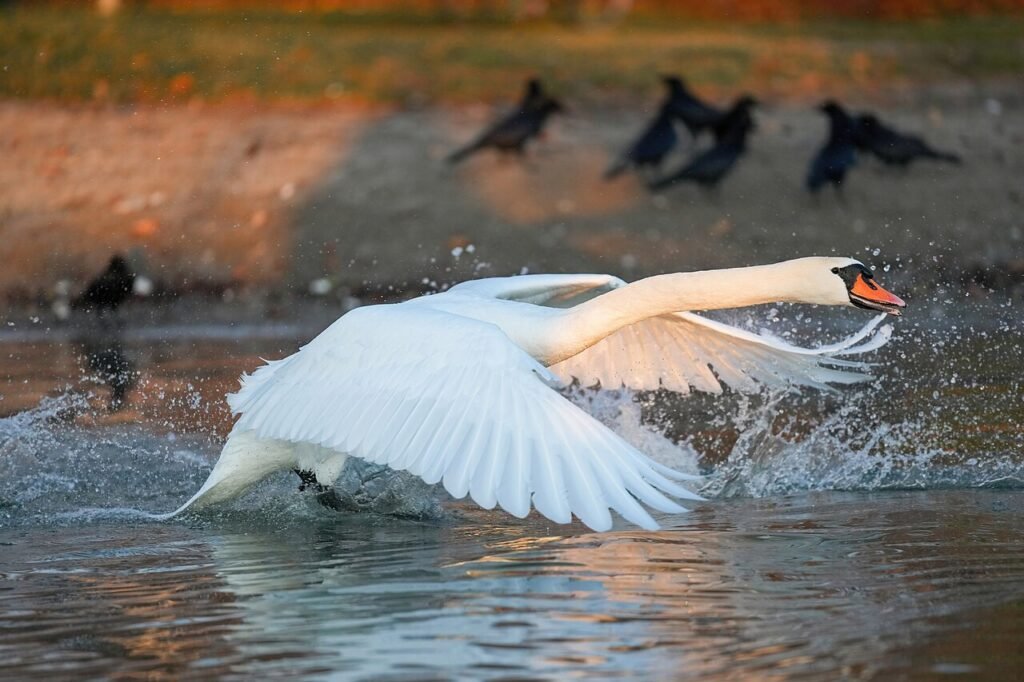
The Clever Swans and the Rushing River
The Clever Swans and the Rushing River — A flock of clever swans must cross a flooding river. A short story for kids about clever thinking, teamwork and staying calm in times of danger.
The river had been rising for three days, and the flock of swans who lived on its bank knew they needed to cross before the fourth.
On the fourth day, the river would reach the great boulders. When water rushed through the boulders, it became impossible to cross — too fast, too chaotic, too loud even to hear the warning cry of a friend.
There were forty-seven swans in the flock, and they had crossed this river every year for as long as any of them could remember. But this year, the rains had been different. The river was a meter higher than usual, and faster.
The eldest swan, Kate, flew reconnaissance at dawn of the third day. She returned with news that made the flock quiet: the river, at its narrowest crossing point, was already almost impassable. The current had swept a large branch downstream in the time it took her to observe it.
‘We must leave today,’ she said.
‘Some of us cannot make it across in this current,’ said a young male named Ray. He was not complaining or challenging. He was simply observing: among the forty-seven were six cygnets — young swans on their first year of crossing — and two elder birds, Priya and Gary, whose wings had grown less strong with age.
There was a silence.
Then a small cygnet named Victor, who was observing his first migration, said: ‘What if we do not cross the same way?’
Everyone looked at him.
‘The river is fast in the middle,’ said Victor carefully, ‘but it is slower near the banks. At the crossing point, the banks on both sides have a curve that slows the water. We could use the current at the top of the curve to angle across, then rest on the gravel shelf halfway. We would not cross in one flight. We would cross in stages.’
Kate flew the route Victor had described. He was right about the banks. He was right about the gravel shelf, which was still above water, a resting point no one had thought to use because the old way had always worked.
‘Who should go first?’ asked Ray.
‘The strongest swimmers and fliers,’ said Kate. ‘They will make a formation on the far side of the shelf and call to guide the others. The current makes a sound — you can hear where it is fast and where it is slow if you listen from above.’
It took four hours to cross the flock. The six cygnets were each flanked by two adults during the second stage, where the current was strongest. Priya and Gary crossed last, in the slow water of the lower bank curve, with three young adults flying alongside them not to carry them but to steady them if the wind shifted.
On the far bank, when all forty-seven had crossed, there was a long quiet moment.
Then Kate looked at Victor, who was ruffling his feathers dry and looking at the river with the expression of someone who had just discovered something important about himself.
‘You solved the problem,’ she said.
‘I only noticed the bank,’ said Victor.
‘Yes,’ said Kate. ‘That is the thing about problems. They are usually solved by whoever is paying careful attention to the part of the problem that everyone else stopped looking at.’
🌟 Moral: Cooperation means each person contributing what they specifically notice and can do. The youngest, the least experienced, the most recently arrived — sometimes they are the ones who see what everyone else has stopped looking at, precisely because they have not yet learned to assume they know the answer.
Related Reading
- The Clever Jackal and the Wicked Lion
- The Foolish Tortoise and the Clever Swans
- The Monkey and the Crocodile
More: English Short Stories · Stories in 14 languages · Srikaram home
✍️ Have a story or article to share? Submit it for review and get published on Srikaram.org.