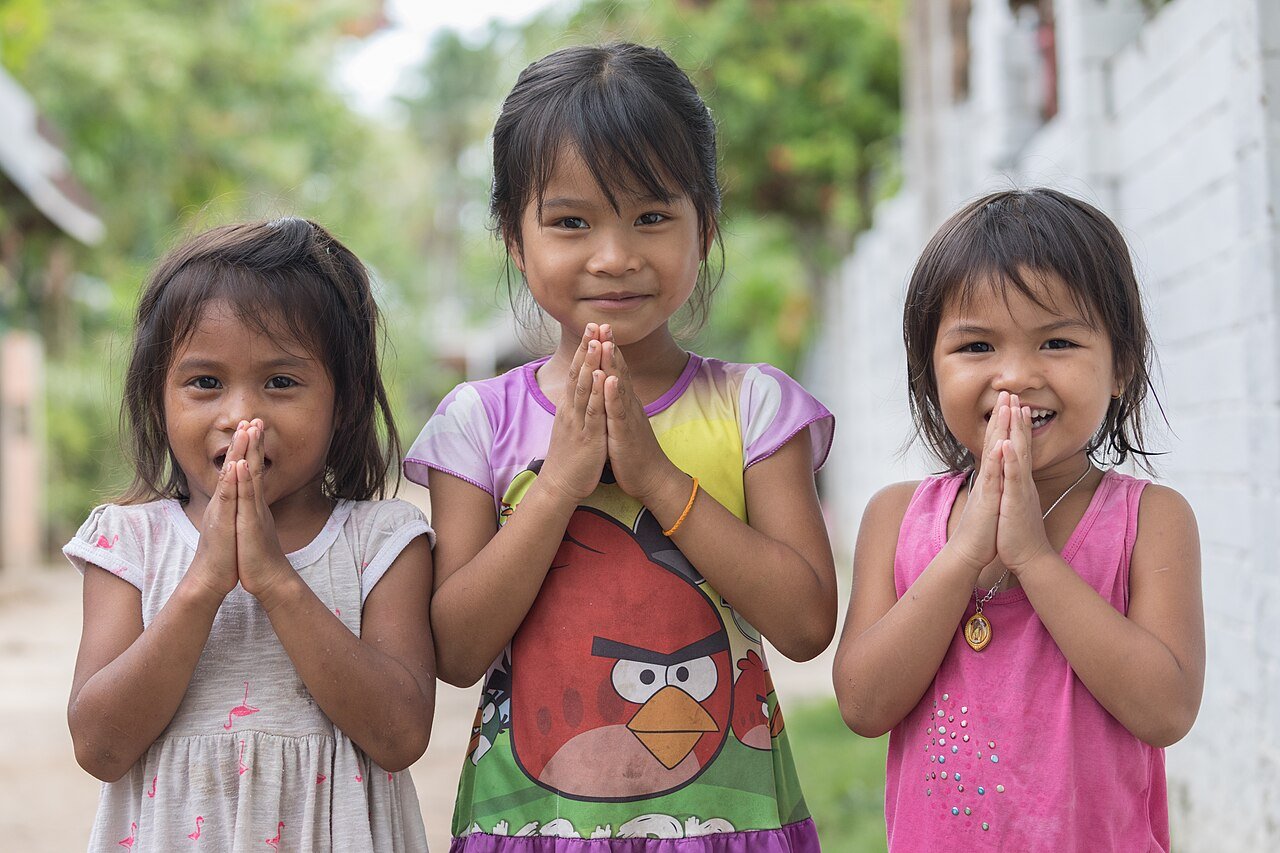
Image: <a href="https://commons.wikimedia.org/wiki/File:Portrait_photograph_at_bust_length_of_three_Lao_girls_joining_their_palms_for_the_Thai_greeting,_front_view,_in_Don_Khon,_Laos.jpg" rel="nofollow noopener" target="_blank">Basile Morin / Wikimedia Commons</a> (CC BY-SA 4.0)
In Telugu culture, how you speak to someone matters just as much as what you say. Telugu has a rich system of respectful words and forms that show care and politeness, especially toward elders.
This guide explains common Telugu greetings and how to use respect words like andi and garu, so children can speak confidently and politely with family and community.
Common Telugu Greetings
- Namaskaram (నమస్కారం) – Hello / Greetings (respectful, usually with folded hands)
- Baagunnaaraa? (బాగున్నారా?) – Are you well? (respectful)
- Baagunnaavaa? (బాగున్నావా?) – Are you well? (informal, for friends and younger people)
- Ela unnaru? (ఎలా ఉన్నారు?) – How are you? (respectful)
- Bhojanam chesaaraa? (భోజనం చేశారా?) – Have you eaten? (a very common, caring greeting)
- Vellostaanu (వెళ్ళొస్తాను) – I’ll go and come back (the traditional way to say goodbye)
Notice that Telugu speakers rarely say “goodbye” directly. Vellostaanu, meaning “I’ll go and come back,” expresses hope of meeting again.
What Does “Andi” Mean?
Andi (అండి) is a small but powerful word that adds respect and politeness. It can be used:
- As “yes”: Andi or Avunandi (Yes, respectfully)
- At the end of a sentence: Randi (Please come), Koorchondi (Please sit)
- To get attention politely: Andi! (Excuse me!)
Think of andi as similar to adding “please” or “sir/madam” in English.
What Does “Garu” Mean?
Garu (గారు) is added after a person’s name or title to show respect, similar to “Mr.,” “Mrs.,” or “Sir/Madam.”
- Ramarao garu – Mr. Ramarao
- Teacher garu – Respected teacher
- Doctor garu – Respected doctor
- Amma garu – Respected mother (often used for older women)
Children often use garu with teachers, family friends, and elders outside the immediate family.
Respectful vs. Informal Forms
Telugu verbs change depending on who you are talking to:
- Come: Raa (informal) → Randi (respectful)
- Sit: Koorcho (informal) → Koorchondi (respectful)
- Eat: Tinu (informal) → Tinandi (respectful)
- You: Nuvvu (informal) → Meeru (respectful)
Use informal forms with friends, younger siblings, and children. Use respectful forms with parents (in many families), grandparents, teachers, and anyone older or unfamiliar.
Addressing Family Members
Telugu children don’t usually call elders by their first names. Instead, they use relationship words: Ammamma, Thatha, Mamayya, Pinni, Anna, Akka. This shows both love and respect.
Other Polite Words
- Dhanyavaadaalu (ధన్యవాదాలు) – Thank you (formal)
- Kshaminchandi (క్షమించండి) – Sorry / Excuse me
- Dayachesi (దయచేసి) – Please
In everyday speech, many Telugu speakers simply say “thanks” or “sorry” in English, but knowing the Telugu words is valuable.
Practice Ideas
- Role-play greetings with grandparents on video calls.
- Respect game: Say an informal word (raa), and your child changes it to respectful (randi).
- Festival visits: Before visiting relatives, practise namaskaram and baagunnaaraa?
- Name tags: Practise adding garu to names of teachers and family friends.
Final Thoughts
Using andi, garu, and respectful forms is more than grammar; it’s a way of showing care. When children learn these Telugu greetings and manners, they build warm connections with elders and carry forward a beautiful part of Telugu culture.
You May Also Enjoy
- How to Seamlessly Introduce Telugu to English-Speaking Toddlers
- 7 Telugu Words That Have No Direct English Translation
- The Hidden Mathematical Genius Behind Telugu Chandassu (Poetic Meter)
More: Telugu Language · Stories in 14 languages · Srikaram home
Image: Basile Morin / Wikimedia Commons (CC BY-SA 4.0)
✍️ Have a story or article to share? Submit it for review and get published on Srikaram.org.