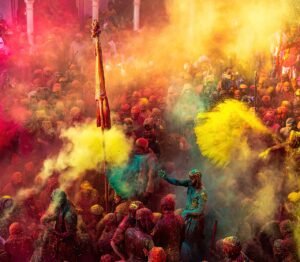
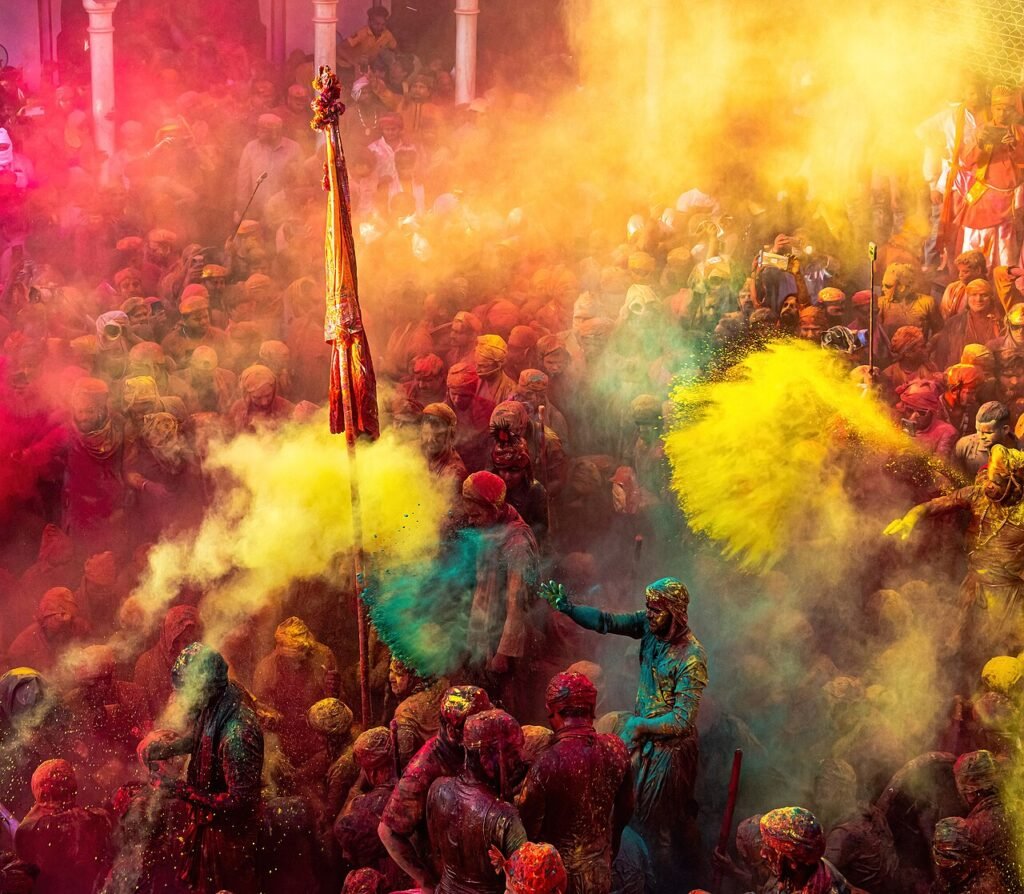
Image: <a href="https://commons.wikimedia.org/wiki/File:Lathmar_Holi_2022_in_Nandgaon,_Uttar_Pradesh_(edited).jpg" rel="nofollow noopener" target="_blank">Original: Sachinghai09 Derivative work: Radomianin / Wikimedia Commons</a> (CC BY-SA 4.0)
Imagine a morning when the whole neighborhood steps outside, laughing, holding handfuls of bright powder in pink, green, yellow, blue and orange. Friends chase each other with water balloons and squirt guns. Grandparents gently dab color on children’s cheeks and give blessings. Music plays, drums beat, and by noon everyone looks like a walking rainbow. This joyful day is Holi, the Festival of Colors, one of the most beloved celebrations in India.
Holi marks the end of winter and the arrival of spring. It is celebrated by Hindus across India and Nepal, and by Indian communities around the world, from London to Dallas to Trinidad. In this article, we will explore the legends behind Holi, the traditions of different regions, the special foods families prepare, and how to celebrate safely and kindly.
When Is Holi Celebrated?
Holi follows the Hindu lunar calendar. It falls on the full moon day (Purnima) of the month of Phalguna, which usually comes in late February or March. Because it depends on the moon, the date changes every year on the Western calendar.
Holi is usually celebrated over two days:
- Holika Dahan (Choti Holi): On the evening of the full moon, communities light bonfires.
- Rangwali Holi (Dhulandi or Dhuleti): The next morning, people play with colors.
The Legend of Prahlad and Holika
The most famous story behind Holi comes from Hindu scriptures called the Puranas. Long ago, there lived a proud and powerful demon king named Hiranyakashipu. He had received a special blessing that made him nearly impossible to defeat, and he demanded that everyone worship him instead of the gods.
But his young son, Prahlad, refused. Prahlad was a devoted follower of Lord Vishnu, the protector of the universe. No matter how much his father threatened him, Prahlad kept praying to Vishnu with a calm and fearless heart.
Furious, the king tried many times to punish his son, but each time Prahlad was miraculously saved. Finally, the king turned to his sister, Holika, who had a magical shawl that protected her from fire. Holika tricked Prahlad into sitting on her lap in the middle of a blazing fire. But as the flames rose, the shawl flew from Holika’s shoulders and wrapped around Prahlad. Holika was consumed by the fire, while Prahlad walked out unharmed.
Later, Vishnu appeared as Narasimha, a being who was half man and half lion, and defeated Hiranyakashipu, ending his cruelty.
The bonfire of Holika Dahan recalls this story. It symbolizes the victory of good over evil, of faith over arrogance. Families gather around the fire, walk around it, offer grains, coconuts and sweets, and pray for the burning away of negativity in their lives.
Radha, Krishna and the Colors of Love
The colorful part of Holi is closely linked to Lord Krishna, one of the most beloved Hindu deities. As a child, Krishna was known for being playful and mischievous. According to a popular tale, young Krishna, who had dark blue skin, once asked his mother, Yashoda, why his beloved friend Radha was so fair while he was so dark. His mother laughed and playfully suggested that he color Radha’s face in any color he liked. So Krishna smeared colors on Radha’s face, and the tradition of playing with colors was born.
This is why Holi celebrations are especially grand in the Braj region of Uttar Pradesh, where Krishna is said to have grown up, including the towns of Mathura, Vrindavan, Barsana and Nandgaon. In this region, Holi festivities can last for more than a week.
Special Holi Traditions Across India
Lathmar Holi in Barsana
In the town of Barsana, said to be Radha’s birthplace, a unique tradition called Lathmar Holi takes place. Men from Nandgaon, Krishna’s village, come to Barsana and playfully try to color the women. The women respond by “attacking” them with long bamboo sticks (lathis) while the men protect themselves with shields. It is all in good fun and recalls the playful teasing between Krishna and the gopis (milkmaids).
Phoolon ki Holi in Vrindavan
At the Banke Bihari Temple in Vrindavan, priests shower devotees with flower petals in a celebration called Phoolon ki Holi, the Holi of flowers.
Hola Mohalla in Punjab
Sikhs celebrate Hola Mohalla the day after Holi at Anandpur Sahib. Started by Guru Gobind Singh, it features displays of martial arts, horse riding, poetry and community meals.
Basanta Utsav in West Bengal
In Shantiniketan, the poet Rabindranath Tagore introduced Basanta Utsav, a spring festival where students dressed in yellow sing and dance, gently applying colored powder.
Shigmo in Goa and Rang Panchami in Maharashtra
In Goa, the spring festival of Shigmo features parades and folk dances, while in Maharashtra, people play with colors on Rang Panchami, five days after Holi.
Holi Foods and Treats
No festival in India is complete without special foods. During Holi, kitchens are busy for days.
- Gujiya: Half-moon-shaped pastries filled with sweetened khoya (milk solids), coconut, nuts and cardamom, then fried until golden. Gujiya is the signature sweet of Holi.
- Thandai: A cool, creamy drink made from milk, almonds, fennel seeds, rose petals, cardamom, saffron and pepper.
- Malpua: Sweet pancakes soaked in sugar syrup.
- Dahi bhalla (dahi vada): Soft lentil dumplings soaked in yogurt and topped with sweet and tangy chutneys.
- Puran poli: A sweet flatbread popular in Maharashtra.
- Namak pare and mathri: Crunchy, salty snacks.
The Meaning of Holi
Holi is more than a party. It carries deep messages:
- Good triumphs over evil: As shown in the story of Prahlad.
- Equality: On Holi, everyone gets colored, whether rich or poor, young or old. Social differences fade under the colors.
- Forgiveness and fresh starts: Many people use Holi to mend broken friendships, forgive old quarrels and begin again. A common greeting is “Bura na mano, Holi hai!” which means “Don’t feel bad, it’s Holi!”
- Welcoming spring: Holi celebrates nature’s renewal, the blooming of flowers and the harvest of winter crops.
Playing Holi Safely and Kindly
Holi should be fun for everyone. Here are tips for families:
- Use natural or skin-safe colors. Traditionally, colors were made from flowers such as the bright orange palash (flame of the forest), turmeric, beetroot and henna. Many families now make or buy natural, non-toxic colors.
- Protect skin and hair. Apply coconut oil to skin and hair before playing so colors wash off more easily.
- Protect eyes and ears. Avoid throwing color toward faces, and never aim water balloons at people’s heads.
- Respect consent. Only play with people who want to play. If someone says no, respect it.
- Save water. Many communities now celebrate with dry colors to save water.
- Be kind to animals. Never put color on pets or street animals, as it can harm them.
Holi Around the World
Holi has spread far beyond India. It is celebrated in Nepal, Mauritius, Fiji, Guyana, Suriname, Trinidad and Tobago, and among Indian communities in the United States, the United Kingdom, Canada and Australia. Many universities and cities host public Holi events, and people of all backgrounds join in.
Fun Facts for Kids
- The palash tree’s bright orange flowers were traditionally boiled to make a natural Holi color.
- Holi is sometimes called the “Festival of Love.”
- In some villages, people sing special folk songs called phag or hori during the festival.
Discussion Questions for Parents and Teachers
- What does the story of Prahlad teach us about courage and faith?
- Why do you think Holi helps people forget their differences?
- Is there someone you would like to forgive or make up with, in the spirit of Holi?
- How can we celebrate festivals in a way that protects nature and animals?
Conclusion
Holi is a festival of joy, color and new beginnings. It reminds us that good can overcome evil, that love can wash away old hurts, and that the arrival of spring is something worth celebrating together. Whether you play with colors in a village in Uttar Pradesh or in a park in Texas, the spirit of Holi is the same: open your heart, share sweets, and let the world be a little brighter.
Image: Original: Sachinghai09 Derivative work: Radomianin / Wikimedia Commons (CC BY-SA 4.0)
✍️ Have a story or article to share? Submit it for review and get published on Srikaram.org.