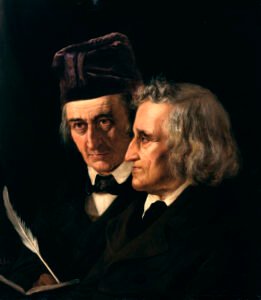
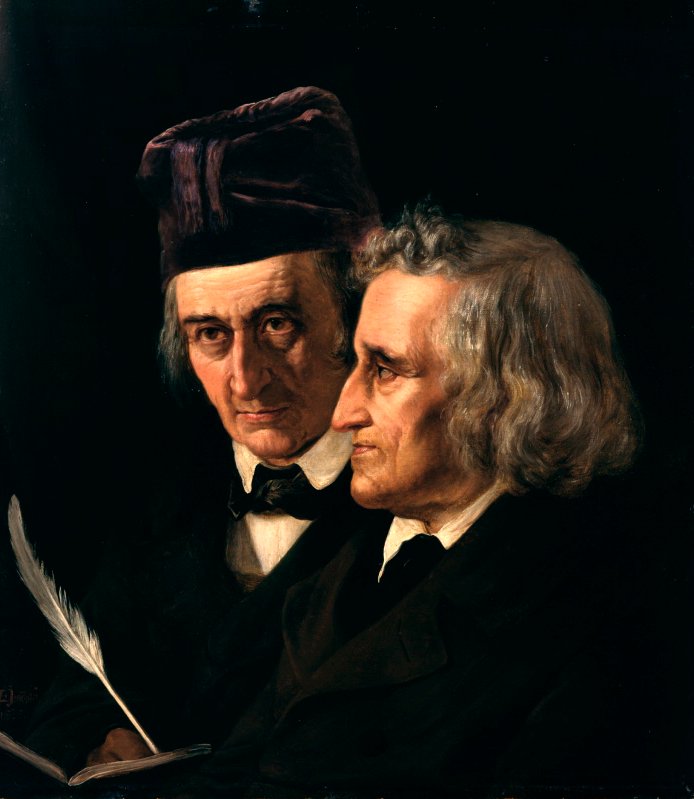
Image: <a href="https://commons.wikimedia.org/wiki/File:Grimm.jpg" rel="nofollow noopener" target="_blank">Elisabeth Baumann / Wikimedia Commons</a> (Public domain)
Once upon a time, in a land of deep forests and old castles, there lived two brothers who loved stories. They did not write stories themselves, at least not at first. Instead, they listened. They visited storytellers, read old books and wrote down the tales that grandmothers, servants, farmers and neighbors had told for generations. Thanks to their work, children all over the world know the stories of Hansel and Gretel, Little Red Riding Hood, Snow White, Rapunzel, Cinderella and Rumpelstiltskin.
These brothers were Jacob and Wilhelm Grimm, known together as the Brothers Grimm. Their collection of fairy tales is one of the most translated and widely read books in history, and in 2005, UNESCO added their original handwritten copies to its Memory of the World register. In this article, we will discover the lives of the Grimm brothers, how they collected their stories, what makes their tales special, and where you can follow their footsteps in Germany today.
Two Brothers, One Lifelong Partnership
Jacob Grimm was born in 1785, and Wilhelm Grimm was born in 1786, in the town of Hanau, in the region of Hesse in central Germany. They were two of several children in their family. Their father was a lawyer and official, and the family lived comfortably in the small town of Steinau, until their father died suddenly when the boys were young. The family faced hard times, and Jacob, as the eldest son, felt responsible for helping care for his mother and siblings.
The brothers were extremely close. They studied together, worked together, and for most of their lives even lived together. They both studied law at the University of Marburg, but they became fascinated by language, history and old literature. They began to wonder: what were the stories that ordinary German people had told each other for centuries?
Why Collect Folk Tales?
In the early 1800s, the land we now call Germany was not one country. It was divided into many separate kingdoms, duchies and states. During this time, much of the region was occupied by the armies of Napoleon of France. Many Germans felt a strong desire to discover and protect their shared culture, language and traditions.
The Grimm brothers believed that folk tales, stories passed down by word of mouth, held the heart and history of the German people. They worried these stories might disappear as the world changed and older storytellers passed away. So they set out to collect and preserve them.
Who Told the Stories?
People often imagine the Grimms traveling from village to village, listening to old peasants by the fireside. In fact, many of their tales came from educated, middle-class friends and acquaintances, especially young women, who had heard the stories from nursemaids, servants and family members.
Some important storytellers included:
- Dorothea Viehmann, a tailor’s widow from near Kassel, who sold vegetables at the market. She had a remarkable memory and told the Grimms dozens of stories, which she could repeat almost word for word. Her portrait appeared in later editions of the book.
- The Hassenpflug family, especially the sisters, who shared stories, some with French influences.
- The Wild family, including Dortchen Wild, who told Wilhelm many tales. Wilhelm later married her.
- Members of the von Haxthausen family, who contributed stories from the Westphalia region.
Some tales had roots in other countries too. Stories like Cinderella and Sleeping Beauty were known across Europe, and French writer Charles Perrault had published versions over a century earlier. This shows how stories travel and change as people share them.
Children’s and Household Tales
In 1812, the brothers published the first volume of their collection, called Kinder- und Hausmärchen (“Children’s and Household Tales”). A second volume followed in 1815. Together, they contained more than 150 stories.
At first, the book was meant mainly for scholars, with many footnotes and notes about sources. Some readers felt the stories were too rough or frightening for children. Over the following decades, Wilhelm in particular revised the tales many times, making the language more polished and storybook-like, adding the classic opening “Once upon a time” (Es war einmal), and softening some content. By the final edition in 1857, the collection included more than 200 stories. A smaller edition with illustrations, intended for families, became a bestseller.
Famous Grimm Tales
Here are some of the best-known stories from the collection:
- Hansel and Gretel: Two siblings, lost in the forest, find a house made of bread and sweets, only to discover it belongs to a wicked witch. Clever Gretel saves the day.
- Little Red Cap (Little Red Riding Hood): A girl meets a sly wolf on her way to visit her grandmother.
- Snow White (Schneewittchen): A princess flees her jealous stepmother and finds shelter with seven dwarfs.
- Rapunzel: A girl with incredibly long hair is locked in a tower by an enchantress.
- Cinderella (Aschenputtel): In the Grimm version, Cinderella’s help comes not from a fairy godmother but from a magical hazel tree growing on her mother’s grave and from helpful birds.
- Rumpelstiltskin: A miller’s daughter must guess the secret name of a strange little man who can spin straw into gold.
- The Frog King: A princess makes a promise to a frog who rescues her golden ball.
- Sleeping Beauty (Little Briar Rose): A princess falls into a hundred-year sleep.
- The Bremen Town Musicians: Four aging animals, a donkey, a dog, a cat and a rooster, set off to become musicians and outwit a band of robbers.
- The Elves and the Shoemaker: Tiny helpers secretly make shoes for a poor shoemaker.
- The Golden Goose, Mother Hulda, The Fisherman and His Wife and many more.
Why Are Grimm Tales Sometimes Dark?
The original Grimm stories can be surprising to modern readers because some include frightening or harsh moments. Wolves eat grandmothers, witches threaten children, and villains often receive severe punishments. Remember that these stories come from a time when life was difficult. Many families faced hunger, illness and danger from wild forests. Folk tales helped people express fears, teach lessons and imagine a world where courage, kindness and cleverness win.
In most of the stories, the characters who are humble, brave, honest and kind are rewarded, while those who are cruel, greedy or vain face consequences.
Lessons in the Tales
Grimm fairy tales carry many timeless messages:
- Courage: Small or ordinary heroes can overcome great dangers.
- Cleverness: Wit often defeats strength, as in Hansel and Gretel or The Bremen Town Musicians.
- Kindness: Characters who help others, even animals or strangers, are often rewarded.
- Keeping promises: As in The Frog King.
- The dangers of greed: As in The Fisherman and His Wife, where a wife’s endless wishes lead to losing everything.
- Perseverance: Heroes keep going despite hardships.
More Than Fairy Tales
The Brothers Grimm were also serious scholars of language.
- Jacob Grimm studied how languages change over time. He described a pattern of sound changes in Germanic languages known as Grimm’s Law, which helps explain why English words like “father” relate to Latin “pater.” He is considered a founder of the scientific study of the German language.
- Together, the brothers began the Deutsches Wörterbuch, an enormous German dictionary. It was so huge that they only reached the letter “F” in their lifetimes. Other scholars continued the work, and it was finally completed in 1961, more than a century after it began.
The brothers also took a stand for their beliefs. In 1837, they were among the “Göttingen Seven,” a group of professors at the University of Göttingen who protested when a king abolished their state’s constitution. They lost their jobs for it, but they became symbols of courage and freedom.
Wilhelm died in 1859 and Jacob in 1863. They are buried side by side in Berlin.
The German Fairy Tale Route
Germany celebrates the Grimm brothers with the Deutsche Märchenstraße, the German Fairy Tale Route, a tourist path of about 600 kilometers (around 370 miles) that runs from Hanau, their birthplace, north to Bremen. Along the way, visitors can explore towns, castles and forests linked to the brothers’ lives and their stories:
- Steinau: The brothers’ childhood home, with a museum and puppet theater.
- Kassel: Home of the GRIMMWELT, an interactive museum about the brothers and their work.
- Marburg: Where they studied, with a Grimm-themed path through the old town.
- Sababurg Castle: Known locally as the “Sleeping Beauty Castle.”
- Hamelin (Hameln): Famous for the legend of the Pied Piper, which the Grimms included in their collection of German legends. The town performs the story outdoors in summer.
- Bremen: With a famous bronze statue of the Bremen Town Musicians. Visitors rub the donkey’s front legs for good luck.
Grimm Tales Around the World
The Grimm fairy tales have been translated into more than a hundred languages. They have inspired countless picture books, plays, ballets, operas and films. Many people around the world first met Snow White, Cinderella and Rapunzel through movies based on Grimm stories. Each new version adds its own ideas, continuing the old tradition of stories changing as they are retold.
Fun Facts for Kids
- The phrase “happily ever after” in German stories is often “und wenn sie nicht gestorben sind, dann leben sie noch heute,” meaning “and if they haven’t died, they’re still living today.”
- The Brothers Grimm also collected German legends and myths, not just fairy tales.
- A younger brother, Ludwig Emil Grimm, was an artist who made illustrations for their books.
Discussion Questions for Parents and Teachers
- Why did the Grimm brothers think it was important to save folk tales?
- How do stories change when they are passed from person to person?
- Which Grimm character do you think is the bravest, and why?
- Can you think of a story your family has passed down?
Conclusion
The Brothers Grimm were collectors, scholars and storytellers who understood that ordinary people’s stories are precious treasures. By listening carefully and writing down what they heard, they saved a world of witches and woodcutters, talking animals and clever children for generations to come. Every time a parent reads “Once upon a time” at bedtime, the work of Jacob and Wilhelm Grimm lives on, happily ever after.
Image: Elisabeth Baumann / Wikimedia Commons (Public domain)
✍️ Have a story or article to share? Submit it for review and get published on Srikaram.org.