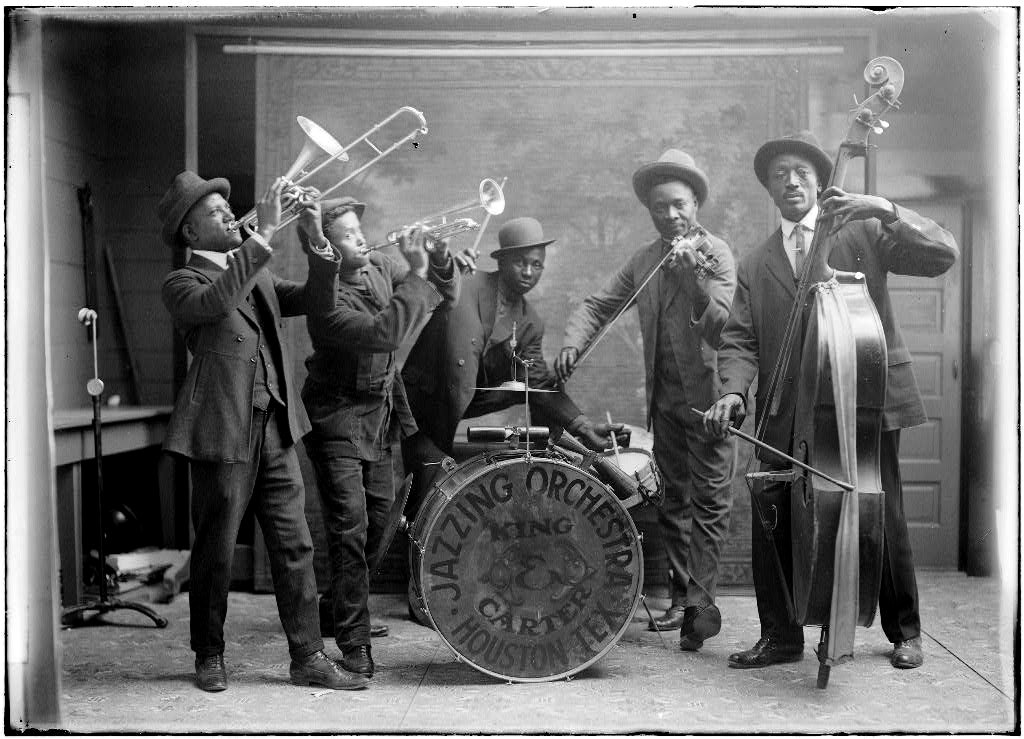
Image: <a href="https://commons.wikimedia.org/wiki/File:CarterAndKingJazzingOrchestra.jpg" rel="nofollow noopener" target="_blank">Unknown authorUnknown author / Wikimedia Commons</a> (Public domain)
Close your eyes and imagine a trumpet sliding up to a bright, high note while a drummer taps a quick, swinging rhythm on the cymbals. A piano answers with a playful run of notes, and a saxophone joins in with a melody nobody planned in advance. That is jazz, a style of music so original and so influential that it is often called America’s greatest gift to world culture.
Jazz has a close cousin called the blues, and together they shaped almost every kind of popular music that came after them, from rock and roll to soul, R&B and hip-hop. In this article, we will travel back in time to discover where these musical styles came from, meet some of the legends who made them famous, and learn why improvisation, the art of making music up on the spot, is so special.
Roots in African American Life
The story of jazz and blues begins with African Americans, many of whom were descended from people brought to America in chains during the era of slavery. Even in the hardest circumstances, enslaved people kept parts of their musical heritage alive: complex rhythms, call-and-response singing, and a deep connection between music, dance and community.
Out of these roots grew several important musical traditions:
- Work songs, sung by groups of laborers in fields or on railroads to keep time and lift spirits.
- Spirituals, religious songs that expressed faith, sorrow and hope for freedom.
- Field hollers, solo cries that carried across the land.
These traditions mixed with European instruments and harmonies, such as the piano, brass horns and church hymns. The result was something completely new.
The Birth of the Blues
The blues developed in the late 1800s and early 1900s, especially in the Mississippi Delta, a flat, fertile region along the Mississippi River. Blues songs often told personal stories about hard times, lost love, travel and loneliness. But the blues is not only sad. Singing about troubles is a way to release them, and many blues songs are full of humor and strength.
A common form is the twelve-bar blues, a pattern of chords that repeats every twelve measures. Musicians all over the world still learn this pattern because it is the foundation of so many songs. Blues singers also use “blue notes,” pitches that are bent slightly lower to create a crying, expressive sound.
W. C. Handy, often called the “Father of the Blues,” wrote down and published blues songs in the 1910s, helping the music spread beyond the South. Later, singers such as Bessie Smith, known as the “Empress of the Blues,” became national stars. When many African Americans moved north to cities like Chicago during the Great Migration, they brought the blues with them. In Chicago, musicians such as Muddy Waters plugged in electric guitars, creating a louder style that inspired rock bands in Britain and America.
New Orleans: The Cradle of Jazz
If the blues grew up in the Delta, jazz was born in New Orleans, Louisiana. In the early 1900s, New Orleans was one of the most culturally mixed cities in the country. French, Spanish, African, Caribbean and Creole traditions all blended together.
In the 1800s, enslaved and free people of African descent gathered on Sunday afternoons in an open space known as Congo Square to drum, sing and dance. These gatherings kept African rhythms alive and helped prepare the ground for jazz.
New Orleans also had brass bands that played at parades, picnics and funerals. A traditional jazz funeral begins with slow, mournful music on the way to the cemetery and ends with joyful, upbeat tunes on the way back, celebrating the life of the person who passed away. That mix of sorrow and joy is at the heart of jazz.
The Magic of Improvisation
What makes jazz different from many other kinds of music is improvisation. In a classical orchestra, musicians usually play every note exactly as written. In jazz, musicians often start with a familiar melody and then take turns creating their own variations in the moment.
Think of it like a conversation. One musician “says” something with a short musical phrase, and another responds. They listen closely, build on each other’s ideas, and surprise one another. No two performances of the same song are ever exactly alike. This requires great skill, deep knowledge of music theory and, most of all, careful listening.
Another key ingredient is swing, a bouncy rhythmic feel that makes people want to tap their feet. Duke Ellington even wrote a famous song declaring that music doesn’t mean a thing if it doesn’t have that swing.
Legends of Jazz
Louis Armstrong
Born in New Orleans in 1901, Louis Armstrong grew up poor but learned the cornet as a boy. He became one of the most important musicians of the twentieth century. His brilliant trumpet solos showed the world that jazz could be a soloist’s art, and his warm, gravelly voice made songs like “What a Wonderful World” beloved across the globe. He also popularized scat singing, using nonsense syllables to imitate an instrument.
Duke Ellington
Edward Kennedy “Duke” Ellington was a pianist, bandleader and composer who wrote more than a thousand pieces of music. His orchestra performed at the famous Cotton Club in New York’s Harlem neighborhood. Ellington treated jazz as serious art and wrote long works that are still performed in concert halls.
Ella Fitzgerald
Known as the “First Lady of Song,” Ella Fitzgerald had a voice that was pure, flexible and full of joy. She could scat faster and more inventively than almost anyone. She won thirteen Grammy Awards over her career.
Others to Know
Children exploring jazz might also enjoy discovering Billie Holiday, Charlie Parker, Dizzy Gillespie, Miles Davis, John Coltrane, Thelonious Monk and Nina Simone. Each brought something new, from the fast and complex style called bebop to the cool, relaxed sound of cool jazz.
The Jazz Age and Beyond
The 1920s are often called the Jazz Age. Radio and records carried the music into homes everywhere, and dances like the Charleston became wildly popular. During the 1930s and 1940s, big bands led by Ellington, Count Basie and Benny Goodman played swing music for huge dancing crowds.
Jazz also played a role in breaking down racial barriers. At a time when segregation divided much of America, integrated bands and audiences showed that music could bring people together.
Over the decades, jazz kept changing. Musicians blended it with Latin music, rock, funk and music from India and Africa. Today, there are jazz festivals on every continent, and UNESCO celebrates International Jazz Day every year on April 30.
How Jazz and Blues Changed World Music
It is hard to overstate the influence of these styles. Rock and roll grew directly from the blues. Soul and R&B borrowed from gospel and blues. Hip-hop artists often sample old jazz records. Even film music and video game soundtracks use jazz harmonies. When you hear a guitar solo, a funky bass line or a singer bending a note, you are hearing the echo of the blues.
How to Enjoy Jazz with Kids
- Listen together. Start with joyful, easy pieces like Louis Armstrong’s recordings or Ella Fitzgerald’s scat songs.
- Play “spot the instrument.” Can you hear the trumpet, the saxophone, the bass and the drums?
- Try call-and-response. One person claps a rhythm; the other answers with a new one.
- Make up a melody. Hum a simple tune, then change it a little each time. That is improvising!
- Visit a local performance. Many cities offer free outdoor jazz concerts in summer.
Fun Facts for Kids
- The word “jazz” first appeared in print around 1912 to 1915, but nobody is certain where it came from.
- Louis Armstrong’s nickname was “Satchmo.”
- A jazz musician’s turn to improvise is called a “solo,” and audiences often clap after each one.
- The saxophone was invented in Belgium by Adolphe Sax in the 1840s, but jazz made it famous.
Discussion Questions for Parents and Teachers
- Why do you think people sang the blues during hard times?
- How is improvising in music like having a conversation with a friend?
- How did jazz help bring people of different backgrounds together?
- Can you name a modern song that might have been influenced by jazz or blues?
Conclusion
Jazz and blues were born from struggle, creativity and community. They carry the voices of people who turned hardship into art and showed the world that music could be free, personal and full of surprise. The next time you hear a saxophone solo or a soulful guitar line, remember the long journey from the fields of the Delta and the streets of New Orleans to the stages of the world.
Image: Unknown authorUnknown author / Wikimedia Commons (Public domain)
✍️ Have a story or article to share? Submit it for review and get published on Srikaram.org.