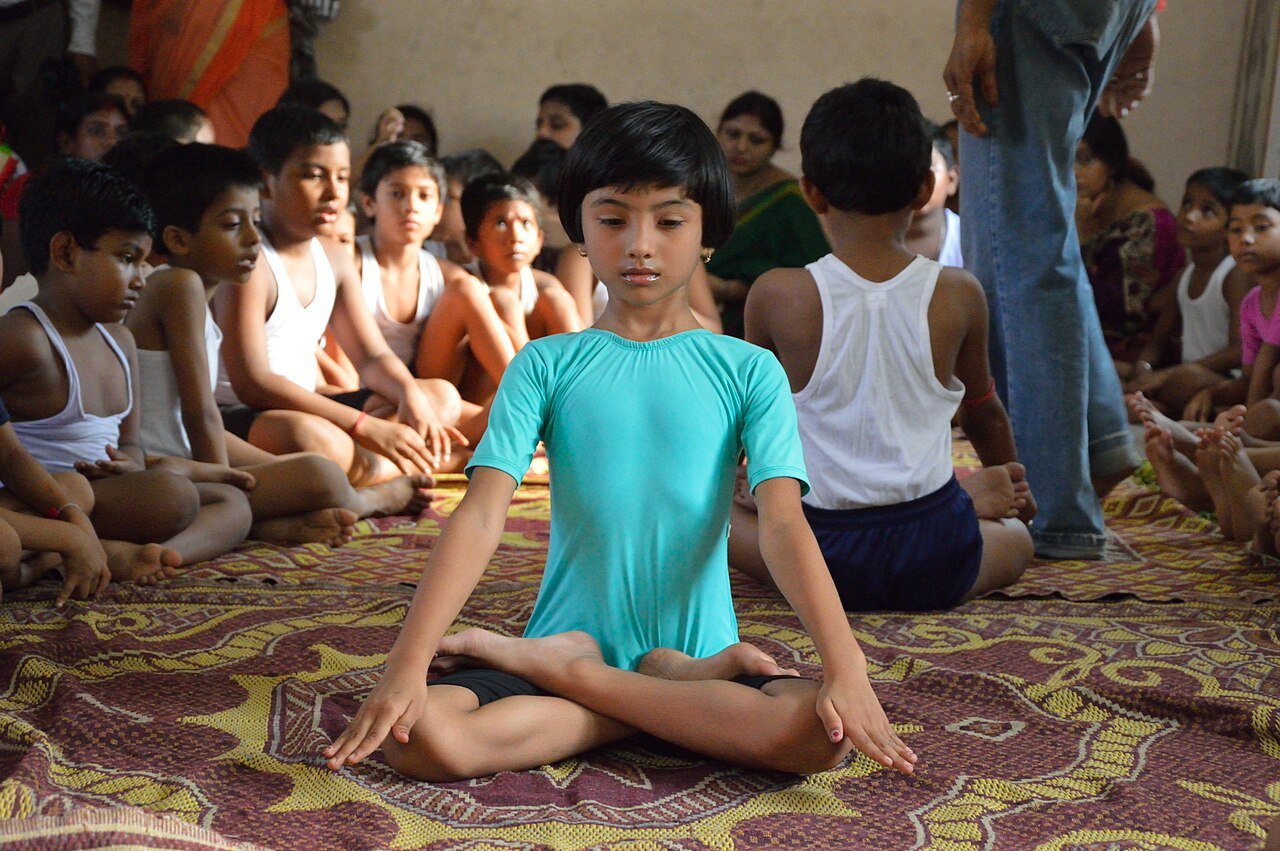
Image: <a href="https://commons.wikimedia.org/wiki/File:Padmasana_-_Yoga_Class_-_Chamrail_-_Howrah_2013-08-24_2027.JPG" rel="nofollow noopener" target="_blank">Biswarup Ganguly / Wikimedia Commons</a> (CC BY 3.0)
Children today juggle school pressures, activities, screens, and big emotions. Mindfulness, paying attention to the present moment with curiosity and kindness, can help them feel calmer, focus better, and handle difficult feelings.
Many schools around the world now include mindfulness in their programmes, and it has deep roots in Indian traditions of meditation and breath awareness. The best part: mindfulness for kids can be simple, playful, and done in just a few minutes a day.
Benefits of Mindfulness for Children
Research on mindfulness programmes for children suggests possible benefits such as:
- Better attention and concentration
- Improved emotional regulation
- Reduced stress and anxiety
- Better sleep
- More kindness and empathy
10 Simple Mindfulness Exercises
1. Balloon Breathing Place your hands on your belly. Breathe in slowly through your nose, filling your belly like a balloon. Breathe out slowly through your mouth, letting the balloon deflate. Repeat five times.
2. Smell the Flower, Blow Out the Candle Pretend to smell a flower (breathe in deeply), then blow out a birthday candle (breathe out slowly). Great for young children.
3. The Five Senses Game (5-4-3-2-1) Name 5 things you can see, 4 you can hear, 3 you can touch, 2 you can smell, and 1 you can taste. This quickly brings attention to the present moment.
4. Mindful Eating Give your child a single raisin, a piece of mango, or a grape. Ask them to look at it, smell it, feel it, and eat it very slowly, noticing every taste.
5. Body Scan Lying down, guide your child to notice each part of the body from toes to head. “Can you feel your toes? Now relax them.” This is wonderful at bedtime.
6. Listening to the Bell Ring a bell, bowl, or temple bell and ask your child to listen until the sound completely disappears. Then raise a hand when they can’t hear it anymore.
7. Glitter Jar Fill a jar with water and glitter glue. Shake it up; the swirling glitter is like a busy mind. Watch together as it slowly settles, just like our thoughts calm down when we breathe.
8. Mindful Walking Walk slowly and quietly, noticing each step: heel, toe, heel, toe. Try it barefoot on grass.
9. Gratitude Moment Before sleep, share three things that made you happy today.
10. Simple Yoga Poses Poses like tree pose (vrikshasana), butterfly pose, and child’s pose combine movement with breath. Keep it fun and gentle.
Tips for Success
- Keep it short: One to five minutes is enough for young children.
- Make it routine: Practise at the same time daily, such as after school or before bed.
- Practise together: Children learn best when adults join in.
- Don’t force it: If your child isn’t interested today, try again another time.
- Use it in hard moments: Once practised, children can use breathing during anger or anxiety.
Mindfulness and Indian Heritage
Breath awareness (pranayama) and meditation (dhyana) are ancient practices in Indian traditions. Sharing simple versions with children, like a few quiet breaths before a meal or chanting “Om” together, can connect them with this heritage in a calm, family-friendly way.
Final Thoughts
Mindfulness isn’t about emptying the mind or sitting perfectly still. It’s about noticing, breathing, and being kind to ourselves. A few minutes a day can give children a lifelong tool for calm and resilience.
You May Also Enjoy
- How Children Learn to Lie — And What It Actually Tells You About Their Development
- The Science of Boredom: Why Your Child’s Boredom Is a Gift You Keep Stealing
- The Sibling Effect: How Brothers and Sisters Shape Intelligence and Character
More: Child Psychology · Stories in 14 languages · Srikaram home
Image: Biswarup Ganguly / Wikimedia Commons (CC BY 3.0)
✍️ Have a story or article to share? Submit it for review and get published on Srikaram.org.