
Solar System for Kids: Fun Facts About the Sun and the 8 Planets
Solar System for Kids — fun facts about the Sun and all 8 planets, from tiny Mercury to windy Neptune, plus moons, dwarf planets and space tips.
Look up at the sky on a clear night, and you’re looking into space. Our home, planet Earth, is part of a huge family called the solar system. Let’s explore it together!
What Is the Solar System?
The solar system is made up of the Sun and everything that travels around it: eight planets, their moons, dwarf planets, asteroids, and comets. The word solar comes from Sol, the Latin name for the Sun.
All of these objects are held in place by the Sun’s gravity, an invisible pull that keeps them moving around it in paths called orbits.
The Sun: Our Star
- The Sun is a star, a giant ball of extremely hot gas.
- It is so big that about 1.3 million Earths could fit inside it.
- Sunlight takes about 8 minutes to travel from the Sun to Earth.
- Without the Sun’s light and heat, there would be no life on Earth.
The 8 Planets in Order
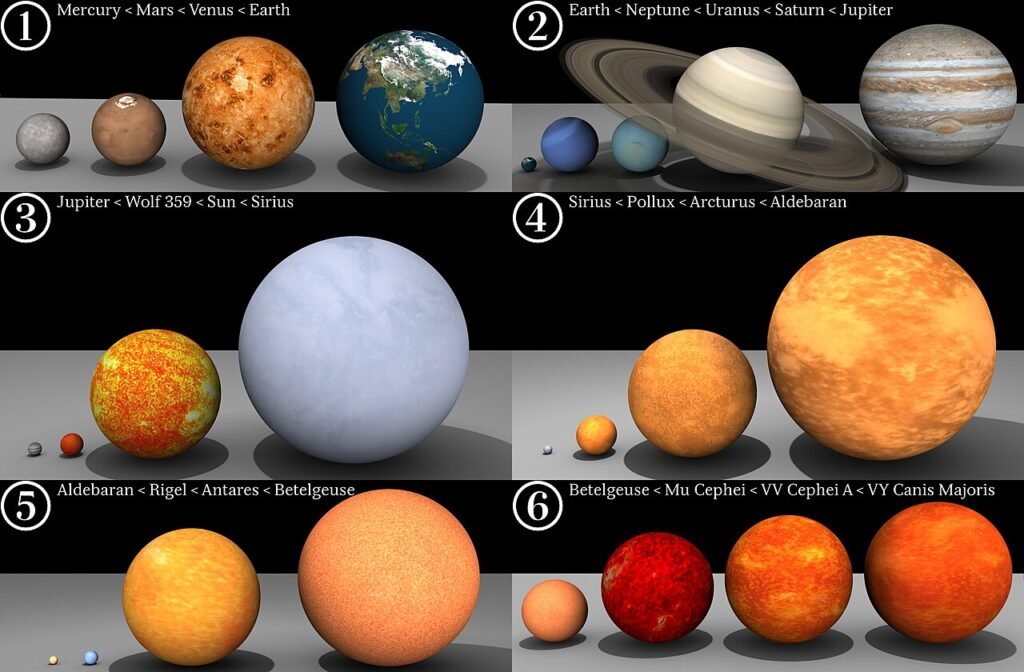
1. Mercury The smallest planet and the closest to the Sun. A year on Mercury (one trip around the Sun) takes only 88 Earth days.
2. Venus The hottest planet, even hotter than Mercury, because its thick clouds trap heat. Venus spins backwards compared to most planets.
3. Earth Our home! It’s the only planet we know of with liquid water on its surface and living things. Earth has one moon.
4. Mars The “Red Planet,” coloured by rusty dust. It has the tallest volcano in the solar system, Olympus Mons. Rovers from Earth are exploring it right now.
5. Jupiter The biggest planet, a giant ball of gas. Its Great Red Spot is a storm bigger than Earth that has lasted for hundreds of years. Jupiter has dozens of moons.
6. Saturn Famous for its beautiful rings, made of ice and rock. Saturn is so light for its size that, in theory, it would float in a giant bathtub!
7. Uranus An ice giant that spins on its side, as if it’s rolling around the Sun. It looks pale blue-green.
8. Neptune The farthest planet from the Sun. It’s cold, dark, and has the fastest winds in the solar system.
An Easy Trick to Remember the Order
Try this sentence: “My Very Educated Mother Just Served Us Noodles.”
The first letter of each word matches a planet: Mercury, Venus, Earth, Mars, Jupiter, Saturn, Uranus, Neptune.
What Happened to Pluto?
Pluto used to be called the ninth planet. In 2006, astronomers decided to call it a dwarf planet because it shares its orbit with many other icy objects. It’s still a fascinating world with mountains of ice!
Rocky Planets vs. Giant Planets
- Rocky (terrestrial) planets: Mercury, Venus, Earth, Mars. Small, with solid surfaces.
- Gas giants: Jupiter and Saturn. Huge, mostly made of gas.
- Ice giants: Uranus and Neptune. Made of gas, water, and ice.
Fun Solar System Activities
- Make a model: Use balls of clay or fruits of different sizes to show the planets.
- Planet walk: In a park, place objects at different distances to show how far apart planets are.
- Moon diary: Draw the Moon’s shape every night for a month.
- Stargazing: On a clear night, look for bright “stars” that don’t twinkle; they might be planets like Venus or Jupiter.
Did You Know?
In Indian astronomy, the planets have traditional names too. In Telugu, Mars is Kuja or Mangala, Jupiter is Guru, and Saturn is Shani, and several days of the week are named after them!
Final Thoughts
The solar system is our neighbourhood in space, full of giant storms, icy rings, red deserts, and mysteries still waiting to be solved. Who knows? Maybe one day, you’ll help explore it.
You May Also Enjoy
- The Power of Play: Why ‘Just Playing’ Is the Most Serious Work of Childhood
- The Hidden Curriculum: What Children Learn When No One Is Teaching Them
- Why the First 1,000 Days of Your Child’s Life Are More Important Than All the Rest
More: Science for Kids · Stories in 14 languages · Srikaram home
✍️ Have a story or article to share? Submit it for review and get published on Srikaram.org.