
The Farmer Who Waited for Rain: A Short Story About Patience and Gratitude
In a village surrounded by rice fields near the Krishna river, two farmers owned land side by side. One was named Bheemanna, a big man with a loud voice who always wanted everything done quickly. The other was Narayana, a quiet old farmer who hummed as he worked.
The Dry Summer
One year, the monsoon was late. June came, and the sky stayed pale and empty. The earth cracked like an old clay pot. The river shrank to a thin, tired stream.
Bheemanna paced his field every morning. “Where is the rain?” he shouted at the sky. “I can’t wait any longer!”
He decided not to wait. He spent all his savings buying water from a tanker and planted his seedlings immediately, hoping to get ahead of everyone else.
Narayana did something different. Every morning, he walked through his field, pulling weeds, fixing the small mud walls between the plots, and clearing the channels that would carry water when it came. In the evenings, he sat under his neem tree with his grandson, Balu.
Balu’s Question
“Thatha,” Balu asked one evening, “why don’t you plant your rice like Bheemanna Mamayya? His field is already green.”
Narayana smiled. “Because the earth has its own clock, Balu. Rice needs the steady rain of the monsoon, not just a bucket of water. If I plant too early, the young plants will be thirsty when the tanker water runs out.”
“But what if the rain never comes?”
“Then I will have lost nothing but a little time. And while I wait, I am not idle. I am preparing.”
Balu did not understand yet. But he began helping his grandfather clear the channels every morning.
The Tanker Runs Dry
By early July, Bheemanna’s money had run out. He could no longer buy tanker water. His young rice plants, so green a few weeks before, began to turn yellow and droop in the heat.
Bheemanna sat at the edge of his field with his head in his hands.
The Monsoon Arrives
Then, one afternoon, the air grew heavy. The birds went quiet. Dark clouds rolled in from the east like great grey elephants. With a crack of thunder, the rain began.
It rained that night, and the next, and the next. Water filled the rivers, the ponds, and the fields.
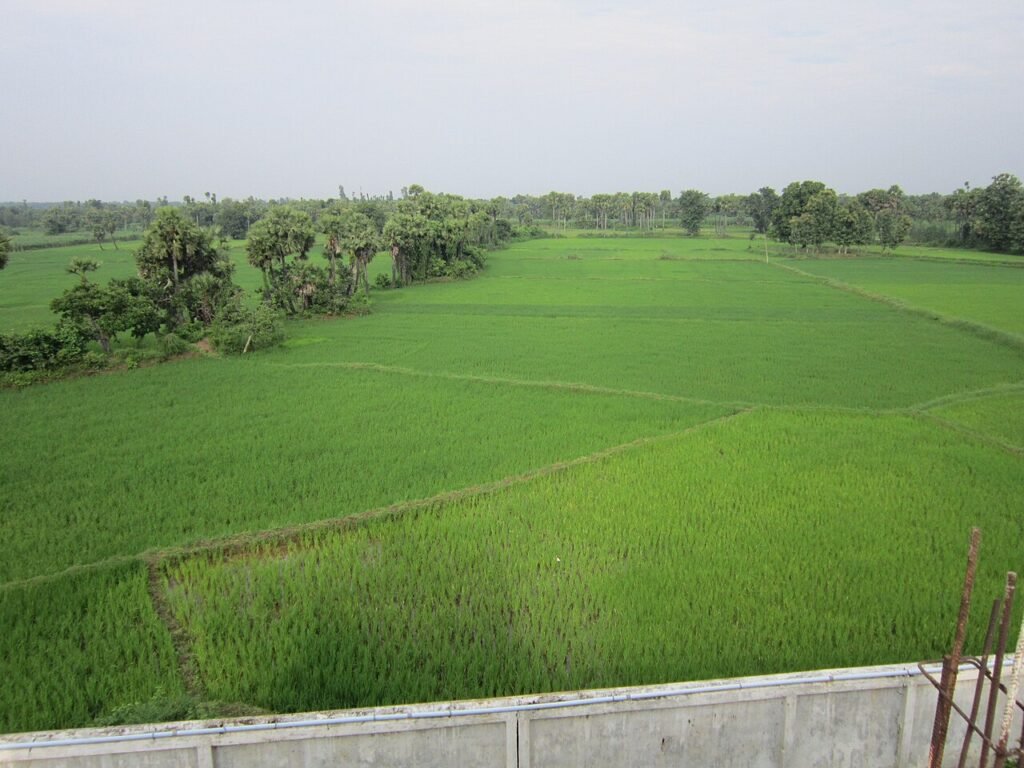
Narayana’s field was ready. Because he had cleared the channels and fixed the mud walls, the rainwater flowed exactly where it was needed. He and Balu planted their seedlings in the soft, soaked earth. Within weeks, the field shimmered like a green silk sari.
Bheemanna’s channels were blocked with weeds and his mud walls had crumbled. The rain rushed across his field and washed away the few plants that had survived.
A Kind Neighbour
Bheemanna came to Narayana’s gate, embarrassed. “I rushed,” he admitted. “I wasted my money and my seedlings. Now I have nothing to plant.”
Narayana did not laugh or scold. He walked to his storeroom and returned with a bundle of seedlings. “I prepared extra. Take them. It is not too late.”
Balu and his grandfather even helped Bheemanna clear his channels. By harvest time, both fields were golden.
The Harvest Festival
At Sankranti, the two families celebrated together, sharing sweet pongali made with the new rice.
Bheemanna raised his plate. “To Narayana, who taught me that waiting is not the same as doing nothing.”
Narayana shook his head humbly. “To the rain,” he said, “and to the earth that feeds us all. We must always be grateful.”
Balu grinned. Now he understood.
Moral of the Story
Patience is not doing nothing. It is preparing while you wait. Rushing often leads to waste, while patience, preparation, and kindness lead to a good harvest. And always be grateful for what nature gives us.
Questions to Discuss
- What was the difference between how Bheemanna and Narayana waited?
- Why was Narayana’s field ready when the rain came?
- How did Narayana show kindness to Bheemanna?
- What is something you are waiting for? How can you prepare while you wait?
This patience story for kids also introduces children to farming life and the importance of the monsoon in India.
You May Also Enjoy
- The Magic Seed of Kindness: A Short Story About Sharing for Kids
- What the Old Banyan Tree Remembered
- The Village That Argued About the River
More: World History & Culture · Stories in 14 languages · Srikaram home
✍️ Have a story or article to share? Submit it for review and get published on Srikaram.org.